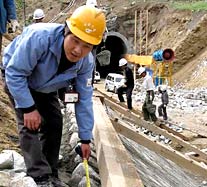
Basang has never laid eyes on a train -- unless you count the ones he's seen in movies or on the old television shows that feed his curiosity about the world beyond the Tibetan plateau.
Now the Lhasa native is a worker on one of the most ambitious railway projects ever undertaken -- a 1,142-kilometer push through jagged peaks and frozen plateaus to connect Tibet's capital with other parts of the country.
The government says the project, begun in 2001, will bring unprecedented economic development and opportunity for the Himalayan region.
For Basang, 22, however, it's just a job -- albeit one that earns him considerably more than the majority of Tibetans, who remain largely herders and farmers, could hope to earn.
"This project will bring economic development, especially tourism," said Basang, who uses no surname following traditional Tibetan practice. And the negative impact? "I don't know of any," he said.
As he spoke, Basang stood beside one of the railroad's key projects, a bridge 900 meters long that will span the Lhasa River at the terminus of the line.
Surrounded by clouded peaks, the river courses under an iron support structure while massive rolling cranes painted with slogans such as "Build a first-class high plateau railway" stand ready to drop steel track in place.
The government is sinking almost 24 billion yuan (US$2.89 billion) into the line, due for completion in July 2005, adding to the billions of US dollars it has already pumped into Tibet, one of the poorest and least developed regions in China.
On the line, all sections are under construction and technical difficulties abound. The air is so thin in some areas -- 900 kilometers of the track will run at more than 4,000 meters -- that workers must wear oxygen masks and train cars will have to be pressurized.
More than 540 kilometers will run over frozen soil that can shift the track as it thaws during the daytime, forcing engineers to devise techniques to keep the ground temperature constant.
Impact on the fragile Himalayan environment is also a concern -- one that builders say they are taking steps to minimize. Measures include cuttings to allow animals such as the endan-gered Tibetan antelope to pass under tracks.
At the Lhasa River bridge, all but 60 of the 800 workers come from engineering companies in central China. Engineer Zhou Yousheng, from the city of Wuhan, typifies sentiments among them: He says the line will bring prosperity to Tibet.
(eastday.com August 27, 2003)