Historic figures in Sino-U.S. relations: Zhou Enlai
'Ping-Pong Diplomacy'
On April 7, 1971, Chinese Chairman Mao Zedong made a decision to invite the United States table tennis team to visit China. On April 14, Premier Zhou Enlai met with the US ping-pong players, the first visiting American guests since 1949. Zhou told the US players: "You open a new historical chapter in the bilateral relations between Chinese people and American people." Just hours after Zhou's welcome of the table tennis players, US President Richard M. Nixon announced initiatives to trade and travel between the US and the People's Republic of China.
Zhou Enlai
|
|
|
Zhou Enlai |
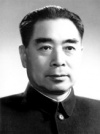
Zhou Enlai (1898-1976), Chairman of the Second, Third and Fourth National Committees of the Chinese People's Political Consultative Conference (CPPCC), styled himself Xiangyu, also called Wuhao, a native of Shaoxing, Zhejiang Province, was born in Huai'an, Jiangsu Province. He studied at Liaoning Dongguan Model School. In 1917 he graduated from Tianjin Nankai Secondary School. In the autumn of the same year, he went to study in Japan and joined the Xing Zhong Xue Hui (Society for China's Rejuvenation), a patriotic organization of students studying in Japan. In June 1919 he returned home, took part in the patriotic May 4th Movement, participated in organizing the Awakening Society, a progressive organization and founded Tianjin Students' Union Journal. In November 1920 he went to France on a work-study program. In 1921 he joined the Communist Party of China (CPC). In 1922 he participated in initiating and organizing the Chinese Youth Communist Party in Europe (later renamed the European branch of the Chinese Socialist Youth League). He served as secretary of the European branch of the Youth League and leader of the European branch of the CPC. After he returned home in the autumn of 1924, he served as chairman of the Guangdong Region CPC Committee, head of its propaganda department, member of its standing committee and director of military affairs, director of the Political Department of the Whampoa Military Academy, director of the Political Department of the First Army of the National Revolutionary Army and general director of the General Political Department of the Eastern Expeditionary Army. In the winter of 1926, he went to Shanghai and served as secretary of the Organization Department of the CPC Central Committee, member of the Military Commission of the CPC Central Committee and secretary of the military commission of Shanghai regional CPC committee. In March 1927 he organized and led the workers' third armed uprising in Shanghai. In May of the same year, he was elected member of the Fifth CPC Central Committee, member of the Political Bureau of the CPC Central Committee and secretary of the Military Commission of the CPC Central Committee in charge of military affairs. On July 12 the CPC Central Committee was reorganized, and he served as member of the Standing Committee of the Political Bureau of the Provisional CPC Central Committee. On August 1 he led and organized the famous Nanchang Uprising and served as secretary of the CPC front committee in the uprising.