Six powers meet on Iran nuclear issue
 0
0 


Diplomats from six powers met behind closed doors on Saturday to discuss how to deal with Iran's nuclear issue at a time when China called for more diplomatic efforts to achieve a comprehensive and long-term solution to the issue.
 |
|
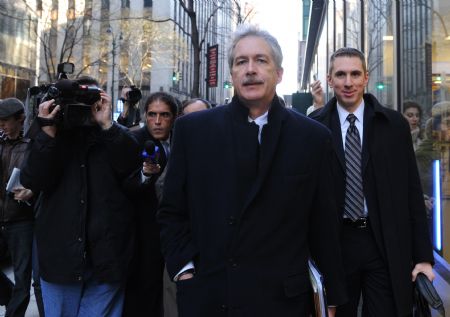
U.S. Under Secretary for Political Affairs William J. Burns (2nd R) leaves after the six powers' discussion on how to deal with Iran's nuclear issue at the European Union Mission in mid-town Manhattan, central New York City, the United States, Jan. 16, 2010. Diplomats from six powers met behind closed doors on Saturday to discuss how to deal with Iran's nuclear issue at a time when China called for more diplomatic efforts to achieve a comprehensive and long-term solution to the issue. The six powers, also known as P5 plus 1, are five permanent members of the UN Security Council -- Britain, China, France, Russia and the United States -- and Germany. [Shen Hong/Xinhua] |
The meeting kicked off shortly after noon (1700 GMT) at the European Union Mission in mid-town Manhattan, central New York City, after the U.S. efforts to push for new sanctions against Iran. The six powers, also known as P5 plus 1, are five permanent members of the UN Security Council -- Britain, China, France, Russia and the United States -- and Germany.
On Tuesday, Chinese Foreign Ministry spokeswoman Jiang Yu told reporters in Beijing, the Chinese capital, that China expected the parties involved in the Iranian nuclear issue to intensify diplomatic efforts, safeguard and promote the process of dialogue and actively seek a comprehensive, long-term and proper solution to the issue.
China has consistently advocated a peaceful resolution of the Iran nuclear issue through diplomatic negotiations, so as to maintain the validity of the international nuclear non-proliferation system and peace and stability in the Middle East region, said Jiang.
"We always believe that sanctions are not the way to solve the root issues," she said.
U.S. Secretary of State Hillary Clinton said on Monday that the Obama administration has concluded that the best way to pressure Iran to come clean on its nuclear ambitions is to impose new sanctions aimed at the country's ruling elite.
Iran repeatedly denied the Western accusations that it is developing nuclear weapons, and insisted that its nuclear program is peaceful and solely geared toward generating electricity for its civilian population.
 |
|
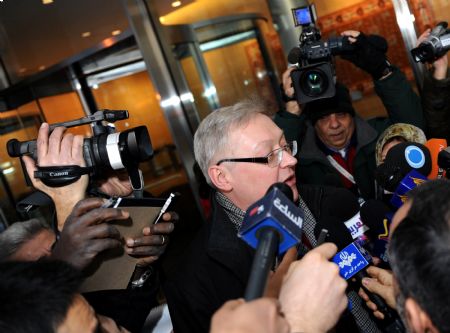
Russian Deputy Foreign Minister Sergei Ryabkov (C) is interviewed after the six powers' discussion on how to deal with Iran's nuclear issue at the European Union Mission in mid-town Manhattan, central New York City, the United States, Jan. 16, 2010. Diplomats from six powers met behind closed doors on Saturday to discuss how to deal with Iran's nuclear issue at a time when China called for more diplomatic efforts to achieve a comprehensive and long-term solution to the issue. The six powers, also known as P5 plus 1, are five permanent members of the UN Security Council -- Britain, China, France, Russia and the United States -- and Germany. [Shen Hong/Xinhua] |


