Multi-party talks best way to deal with DPRK nuclear issue
 0 Comments


The ongoing multi-party talks are the best way to broach the nuclear issue on the Korean Peninsula, a senior Asian expert from the United States alleged.
 |
|
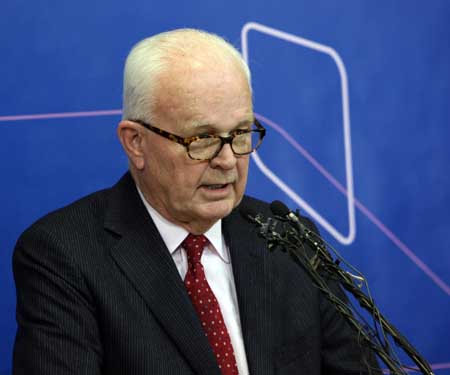
Stephen Bosworth, U.S. special envoy to the Democratic People's Republic of Korea (DPRK), addresses a press conference in Seoul, capital of South Korea, on Dec. 10, 2009. Bosworth said Thursday that the U.S. and the DPRK reached a common understanding on the need for resuming the six-party talks and implementing the Joint Statement of September 2005. [He Lulu/Xinhua] |
Richard C. Bush III, director of the Center for Northeast Asian Policy Studies at the Washington D.C.-based Brookings Institution, told Xinhua: "The Six-Party Talks, with denuclearization of North Korea at its core, is the best way to address all the relevant issues."
With two decades of public service spanning Congress, the intelligence community and the U.S. State Department, Bush said the multilateral venue is promising because the nuclear issue on the Korean Peninsula is a regional issue and not a bilateral one.
Commenting on Stephen Bosworth's remarks of "exploratory talks, not negotiations," Bush said that exploratory talks meant the United States was hoping to determine whether the DPRK is "serious about constructive negotiations."
Bosworth recently went to Pyongyang as the U.S. special envoy and held talks with DPRK First Vice Foreign Minister Kang Sok-ju and Vice Foreign Minister Kim Kye-gwan. Bosworth also communicated U.S. President Barack Obama's view that "complete denuclearization of the Korean Peninsula is the fundamental undertaking of the Six-Party Talks."
Bush made it clear the multi-party talks are more efficient than bilateral negotiations.
"Specifically, North Korea is trying to shift the primary venue for negotiations from the Six-Party Talks to bilateral talks and trying to shift the main agenda item from denuclearization to U.S. policy.
"That is unacceptable to the other parties," he claimed.
He stressed taht the lack of progress on denuclearization is detrimental to improving U.S. relations with the DPRK.
As for the U.S. policy towards the DPRK, Bush reiterated that "the U.S. rejects North Korea's attempt to change the venue and the agenda."
The nuclear issue on the Korean Peninsula, Bush said, "affects the whole region" and the United States as well. The issue, he believed, "must be addressed on a regional basis, not on a bilateral basis."
However, Bush conceded that "this does not mean the United States will not be willing to have bilateral discussions with North Korea for the purpose of reconvening the Six-Party Talks, but the discussions are different from negotiations."
Should the talks resume, Bush said, any success "depends on how seriously all the parties are concerned."
He said the United States has taken "a reasonable position" on the matter -- "but first thing is to embark on the Six-Party Talks in a meaningful way."
The Obama administration said it is open to bilateral talks with DPRK officials, but only in the context of the Six-Party Talks process, which has involved the DPRK, the United States, China, the Republic of Korea, Japan and Russia since 2003.


