US House unveils unified health care bill
 0
0 


US House leaders unveiled Thursday a unified healthcare reform legislation which includes a controversial public health insurance option.
That marks another milestone in the endeavor launched by US President Barack Obama earlier this year to overhaul the country's problematic health care system.
 |
|
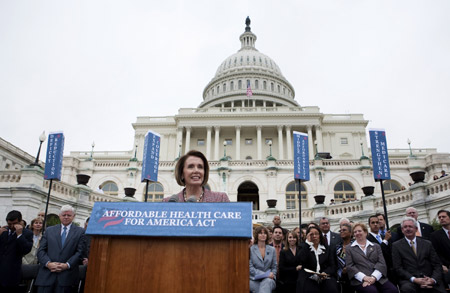
Speaker of the House Nancy Pelosi unveils the House Democrat's Healthcare plan on Capitol Hill in Washington October 29, 2009. [Xinhua] |
"Today, we are ... laying the foundation for a brighter future for generations to come," House Speaker Nancy Pelosi told reporters at a press conference to introduce the new bill.
"For Americans struggling with the cost of health care, this is an urgently needed bill," said House Majority Leader Steny Hoyer. "This is an idea whose time has come."
 |
|
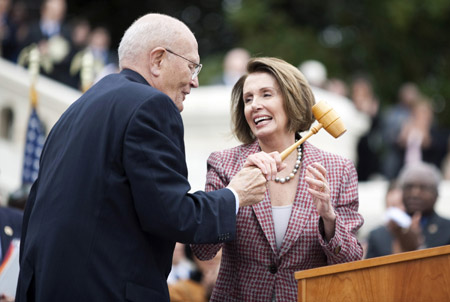
Speaker of the House Nancy Pelosi and Representative John Dingell hold a gavel as the House Democrat's Healthcare plan is unveiled on Capitol Hill in Washington, October 29, 2009. [Xinhua] |
The 2,000-page bill combines three different versions drafted by different House committees and would cost 894 billion US dollars over next 10 years while extending insurance coverage to 36 million Americans currently without health insurance.
It guarantees that 96 percent of Americans have coverage based on an analysis by the nonpartisan Congressional Budget Office.
Among other things, the bill would subsidize insurance for poorer Americans and create health insurance exchanges to make it easier for small groups and individuals to purchase coverage.
It would also cap annual out-of-pocket expenses and prevent insurance companies from denying coverage for pre-existing conditions.
Pelosi's office said the bill would cut the federal deficit by roughly 30 billion dollars over the next decade.
The measure is financed through a combination of a tax surcharge on wealthy Americans and spending constraints in Medicare and Medicaid.
Specifically, individuals with annual incomes over 500,000 dollars as well as families earning more than 1 million dollars would face a 5.4 percent income tax surcharge. Medicare expenditures would be cut by 1.3 percent annually.
Under the public option in the House plan, health care providers would be allowed to negotiate reimbursement rates with the federal government.
Pelosi and other liberal Democrats had argued for a more "robust" public option that ties reimbursement rates for providers and hospitals to Medicare rates plus a 5 percent increase.
Several Democrats representing rural areas, however, complained that doctors and hospitals in their districts would be shortchanged under such a formula.
The House bill differs from legislation now being considered by the Senate in a number of critical ways.
Senate Majority Leader Harry Reid also favors a public option, but would allow individual states to opt out of the plan.
Reid would allow for the creation of nonprofit health care cooperatives; the House bill does not include such a measure.
A bill recently passed by the Senate Finance Committee does not include a tax surcharge on the wealthy, but would instead impose anew tax on high-end health care policies, dubbed "Cadillac plans" by critics.
A large number of House Democrats are adamantly opposed to taxing such policies, arguing that such a move would hurt union members who traded higher salaries for more generous benefits.
The House Democratic leadership is working to post the text of the final bill online early next week and has agreed to give members 72 hours to read it before a vote.
Under that timetable, the House would begin debating the bill at the end of next week.
Any bill passed by the House will eventually have to be merged with legislation passed by the Senate, which hasn't start debating on its version of health care act in the full chamber.
Both chambers would then have to pass a revised measure before sending it to Obama to be signed into law.
In the House, one thorny issue remaining to be resolved among House Democrats is the final abortion language in the bill.


