| Videos | ? Latest |
|
? Feature | ? Sports | ? Your Videos |

Chinese tea faces export challenges
 0 Comment(s)
 Print
Print E-mail CNTV, April 9, 2012


China is one of the biggest tea exporters in the world. As international markets raise the quality standards regarding pesticide residues, Chinese tea companies are searching for new ways to meet the stricter rules.
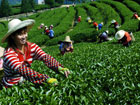
Gao Fuxing has grown oolong tea in Fujian for over 20 years. His tea will be exported to Japan, the biggest importer of Chinese oolong tea. Earlier this year, Japan announced a plan to reduce the tolerance of triazophos in its imports, a pesticide commonly used in China. The change doesn't seem to bother Gao.
Gao Fuxing, tea farmer, said, "I am not worried about it. The company will provide me with the approved pesticides and send an agricultural expert to show me how to use it properly."
Gao Fuxing joined a cooperative scheme last year. He and another 9 farmers have teamed up to deal with a tea export company. The company provides farmers with approved fertilizers and pesticides, and purchases the semi-processed tea from them at higher prices than average level. In return, Gao Fuxing and his partners have to follow the instructions in every step of the production. Gao Shuizhi started this scheme in 2006.
Gao Shuizhi, general manager of Huahong Tea, said, "We purchased semi-processed tea from individual farmers before Japan started the 'Positive List System' in 2006. Under our new scheme, if one farmer violates the thresholds, we will reject the whole cooperative's tea. In this way, farmers will monitor each other to use the pesticides properly; subsequently we can meet the stricter standards by Japan."
According to the 'Positive List System', Japan inspects the use of 276 agricultural chemicals in the products it imports. Violations of the thresholds can result in a shipment being rejected, resulting in the exporter being blacklisted. The EU tests over 400 types of chemicals in imported products. It rejected 4 shipments of Chinese tea this January.
Yan Huai, officer of Quanzhou Entry-Exit Inspection and Quarantine Bureau, said, "The international markets have imposed much stricter requirements to the pesticide residues of importing agricultural products since 2000. Many Chinese exporters shut down or chose the domestic market instead. Chinese tea exporters have to adjust themselves to the international level."
The cooperative scheme is still only in the trial phase. The global pressure has driven these companies to improve every step from production to management.
Facing these more demanding export standards, Chinese tea companies will have to familiarize themselves with the new requirements if they want to have a presence on the global market.


