| Videos | ? Latest |
|
? Feature | ? Sports | ? Your Videos |

There's no place like home

 0 Comment(s)
 Print
Print E-mail
CRI, November 30, 2011
E-mail
CRI, November 30, 2011


The most important values to Chinese people are education and filial piety. Although these values are commonly seen in Chinese culture, society, and in interactions between Chinese people, it is not every day that you can see manifestations in the physical world.
 |
|
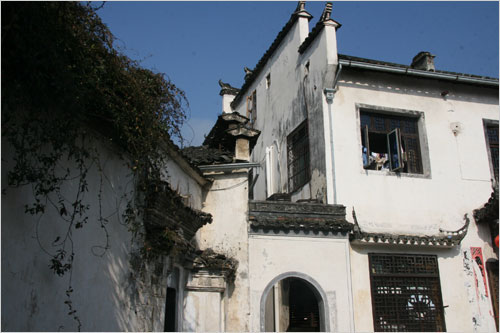
A traditional home in Hong Village in Anhui Province as it was built hundreds of years ago on November 12th, 2011.[CRI] |
Xidi Village and Hong Village are two ancient Anhui villages that have been preserved for hundreds of years.
"Taking good care of your parents - that is the root of a family. The spirit of the family. So what is the root of the family? That is filial piety - kids should love your parents, take good care of your parents. We say the education, the knowledge. If you want to have a bright future, if you want to change your life - study hard. Education, knowledge, may do that. By reading and studying hard, you may find a beautiful wife, a pretty girl to be your wife. You may get a big house, just like this. You may get the high salary, high payment, to be a high official. So the knowledge, education is so important."
Anhui Province in ancient times was characteristically poor. In fact, people had a saying: if you were born in Anhui, it was because you had bad karma in a previous life.
For many Anhui people, the only path to success was to venture out of the province elsewhere in China – or Asia – to become a merchant. Because of this desperation, Anhui merchants, known as Huishang, became the most famous businesspeople in all of China. There is even an expression amongst Chinese people that says there is no town without at least one Huishang.
There are still local people living in these villages in the very same houses that their ancestors built. Indeed, it is because of the strong importance placed on education and loyalty to the family that the Huishang's homes were able to last so long and provide shelter for their descendants centuries later.
After making their fortunes, the Huishangs would return to their hometown. They would use their wealth to build their homes and educate their children. They knew that the key to true power and wealth was education – in this way they could become government officials.
"In Autumn, in Autumn, you would finally come back to your root. The root is Mother. The root is your hometown. The root is your birthplace. Take me for example: if I had the chance to go to your country, maybe just for my business or education, when I get what I want, I will come back to my hometown. Basically, when I am getting old, I will come back to my hometown. Spirit. Traditional mind. People here compared to people in Shanghai, Hangzhou, Beijing, Hong Kong, the big cities, are still traditional. Traditional minds."
The ancient Anhui people were much more inventive with their home construction; nearly every aspect of their homes either served a direct purpose to their lives, or carried some kind of cultural significance.
The walls surrounding traditional Anhui homes are very tall, and windows are a rare feature, often being very small when they do make an appearance. This very deliberate design was to keep out burglars as the men of Anhui were often away on business for long periods of time, leaving their wives, children and elders behind.
Anhui people were strong believers in Fengshui, and thus built their homes to face the riverside, with the backs of their homes to the mountains.
They would also design clever puns on the faces of their homes above the doorway, such as a picture of a horse and a deer, which is a Chinese pun for "quickly achieving a high salary."
These are just some of the features that make Anhui's architecture truly unique.


