| Videos | ? Latest |
|
? Feature | ? Sports | ? Your Videos |

Mystery of China's ancient kilns
 0 Comment(s)
 Print
Print E-mail
CNTV, November 15, 2011
E-mail
CNTV, November 15, 2011


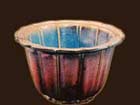
Junyao kiln is one of the most famous of its kind in ancient China. As an old saying goes, one single piece of Junyao porcelain is valued even more than gold, but many mysteries of artistic beauty are still not unveiled. And now after two months effort, archaeologists might give us a clue to the most controversial question... when did it begin?
The latest find at Junyao kiln is in the east of Minzhuang village in Yuzhou city, China’s ancient center to produce Junyao porcelain. Archaeologists have been digging some 500 square meters on the site for two months.Qin Dashu, Professor of Peking University, said "Here we’ve found not only a great deal of porcelain work and broken pieces, but also seven kilns. Some of them are still well preserved. All unveil some uniqueness of Junyao porcelain. "
There are over a hundred Junyao kilns in Yuzhou city, which was named Jun in ancient China. Insiders are still not sure about the origination of Junyao porcelain, especially its starting point. Some experts thought they went back to the Yuan dynasty in the 13th Century, but that may not be the case.
Professor Qin said "The latest excavation has given us some clues to prove that they date back to the early Ming dynasty in the second half of the 14th century. It helps us to clarify the history of Junyao kilns."
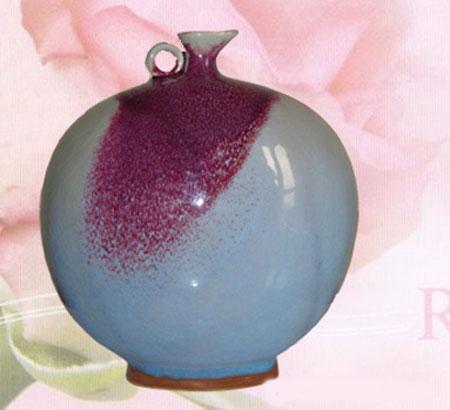
Junyao porcelain is also famed for its variation. There’s another saying that goes no two pieces of Jun porcelain are identical.The distinctive feature of Junyao porcelain lies with its special turbid glaze. It contains low concentrations of copper oxide. When fired, these small traces of copper oxide create brilliant color, usually green infused with violet.Even the blue contained in Jun porcelain was different from the usual celadon; it was a blue with a milky tone.
Adding copper oxide as a coloring agent was a rather difficult task, as the chemical components in the basic glaze, as well as the temperature and atmosphere were all very sensitive factors. Even the smallest bit of deviation from the requirements would have resulted in an undesirable shade of red.
Another distinguishing feature of Jun porcelain glaze was the pattern that resembled trails left in the soil by earthworms. This was a result of the glaze being particularly thick in Junyao ware.
When in the process of baking, under low temperature, the glaze began to chap. When the temperature was raised, glaze that had not congealed flowed back into the crackled creases. Just as the crackle glaze, this defect in firing technology turned into a kind of rich and unique decorative language.


