| Videos | ? Latest |
|
? Feature | ? Sports | ? Your Videos |

Stonehenge mysteries unraveling
 0
0 


Scientists in Wales have made a major discovery that could provide the key to unlocking the mysteries of the stone circle Stonehenge.
Using new technologies they have been able to prove the precise origins of some of the stones that make up the monument. Their discoveries are now fueling debate about how the stones were moved and how the stone circle was constructed.
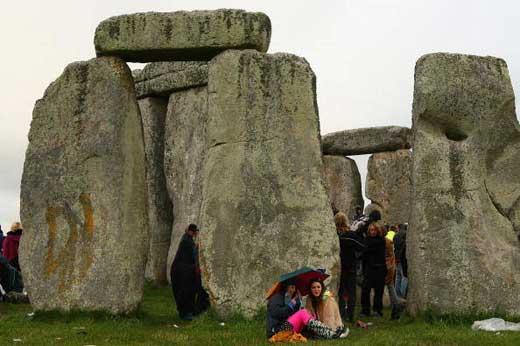
Built around 31-hundred BC, Stonehenge is an ancient site that dominates Salisbury Plain in the south west of England. Much of where the stones came from and how they were moved is still an enigma.
At the National Museum of Wales in Cardiff, some detective work is taking place that could help solve this historical conundrum.
With precision and patience, Dr. Richard Bevins is examining a minute piece of stone that is part of a 5000 year old mystery.
Bevins says the origin of some of the stones is already known.
Dr. Richard Bevins, geologist of National Museum of Wales, said, "Stonehenge comprises an outer circle, an inner circle and an inner horseshoe. The outer circle, which are the very big stones are actually local to the Stonehenge area, to Salisbury Plain."
Still in Wales, at the University of Aberystwyth, geochemist Dr Nick Pearce was tasked with analyzing the zircon crystals that are embedded in the stone samples.
He pioneered a technique that uses a laser to vaporize the crystals so that their chemical make up can be scrutinized. Pearce explains how the technique works.
Dr. Nick Pearce, geochemist of Aberystwyth University, said, "We get hold of the samples as thin sections. We've identified in those where the grains of zircon are that we want to analyze and then we put those samples into the glazer abrasion ISO PMS system, fire a very powerful laser on top of the samples, on the individual grains within the sample. The vapor gets transported then into a mass spectrometer and we analyze the components of that mineral grain."