|
|
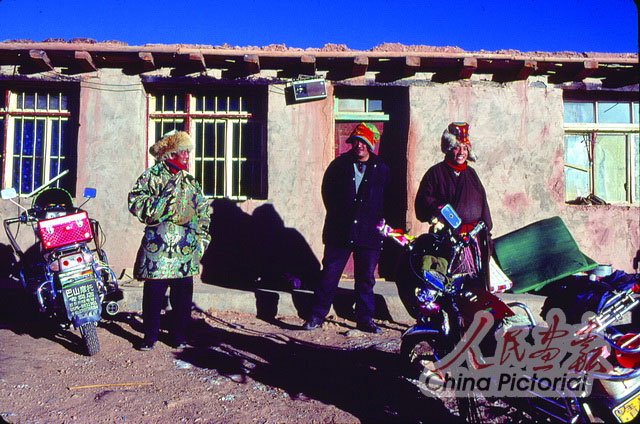
| Today, herders live in permanent homes and motorcycles, not horses, are now the standard mode of transportation. |
I have other concerns as well, based on my dedication to wildlife conservation. Households like to fence part or all of their land for several reasons. Fences clearly delineate boundaries, livestock does not have to be herded, animals can easily be shifted between pastures—and they exclude wildlife. County governments often provide free fencing and may even pay families to erect the fences. As more and more of the open rangelands are fenced, the migrations of chiru may be hampered or stopped and the travels of other species disrupted. Fences are about 120 to 140 cm high — too high for animals to leap over. I have seen dead kiang tangled in fence wires and been told of chiru, blue sheep, and Tibetan gazelle that met a similar fate.
At one time few pastoralists ventured far into the Chang Tang and then only in summer. With the building of roads in the 1950s and 1960s and relocation of families from the south in the 1970s, settlements became established. Today all good rangelands are permanently occupied. Livestock management is a complex cultural and biological system, made especially complicated in a changing economy and policy as at present. And wildlife adds a further level of complexity.
A large part of Tibet's Chang Tang was established as a nature reserve in 1993 and upgraded to national reserve in 1999. Roughly 300,000 sq km in size, the reserve is as large as the whole of Italy. It is considered a multi-use area with equal rights given to pastoralists with their livestock and to the wildlife. However, wildlife cannot speak on its own behalf in times of conflict. In 1990, I first visited the Aru basin in Ali Prefecture. Only a few nomads grazed livestock there seasonally. A census revealed 681 wild yaks and many other animals. In my opinion it was the best wildlife area in the Chang Tang, and I recommended that the Aru basin be given special protection. Nothing was done. A maze of roads now disrupts the whole area, houses are found throughout, and long fence lines cut up the rangelands. One is fortunate to find even a dozen wild yaks today. Indifference and negligence have degraded one of Tibet's natural treasures.