They say music and song have no language barriers. But to keep them alive language is vital.
|
|
|
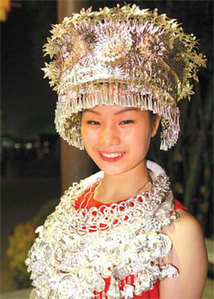
The legendary ethnic Zhuang singer Liu Sanjie on stage. |
Huang Guoguan, director of the Folk Songs Association of Pingguo county in the Guangxi Zhuang autonomous region, spends his time collecting and translating folk songs of the Zhuang people to make them accessible to more people.
Sung in the form of questions and answers, the songs are full of witty ripostes and are considered the origin of the famous ballads from legendary folk song goddess Liu Sanjie. According to Huang, folk songs in Guangxi cover virtually every aspect of people's lives. Through singing, the Zhuang people make friends, find love, welcome guests, and tell the history of their own people.
Though recorded in pictographs derived from Chinese characters, the folk songs could face extinction if not translated into the new standardized Zhuang language, because few people today understand the previous written language, Huang says.
That is why over the past six years he has traveled around Guangxi visiting old singers who are familiar with the traditional art to record whatever has been handed down to them.
To date he has collected more than 30 books of ballad manuscripts, covering over 1,600 folk songs of the Zhuang minority.
But collecting alone is not enough, says Huang. The 50-year-old man is concerned that a key challenge is how to motivate young people to learn more about the art form.
"Most people who sing these ballads are like me, above 50 years old," says Huang. "I would suggest that folk songs should be included into the educational system."
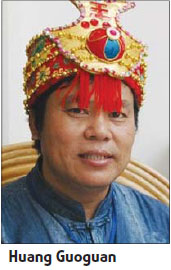
A native in Pingguo county, Huang is a veritable encyclopedia of the songs. He says he is simply captivated by their vitality and richness and regards it a responsibility of all to protect them and pass them down. So he continues his search for the dusty and sometimes damaged manuscripts - which to many seems a hard and pointless mission. He has to settle for a meager salary that is less than what his wife makes.
He has even started to create his own songs, since they simply "flow out naturally" after he spends a whole day singing and learning existing songs. His obsession has gone to such an extent that even in his dreams he is singing them.
It is also his hope to introduce Guangxi's folk songs to the world and in this way, promote Chinese culture on the international stage.
"I'd like to first travel around the country and then go abroad to give performances to all who are interested in the songs. Lectures and teaching are also an alternative," he says.
In October last year, a band of four young singers of the Zhuang ethnic group was invited to the Sydney Opera House for a joint performance of folk arts.
(China Daily December 11, 2008)