Driving
 0 Comment(s)
 Print
Print E-mail
Wikitravel, June 4, 2008
E-mail
Wikitravel, June 4, 2008
Speed Limits
Speed limits are as follows:
30 km/h(19 mph) on city roads where there is only one lane per direction,40 km/h(25 mph) on China National Highways;
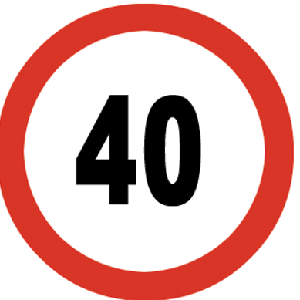
up to70 km/h(43 mph) on city roads where there is a major road with central reservation or two yellow lines,80 km/h(50 mph) on China National Highways;
100 km/h(62 mph) on city express roads;
120 km/h(75 mph) on expressways.
Tolerance is generally around10 km/h(6 mph). Some expressways may have tolerance set all the way up to20 km/h(12 mph); however, anything around15 km/h(9 mph) to20 km/h(12 mph) over the stated speed limit is relatively high risk.
Speed traps are conveniently identified with the characters "雷達(dá)測(cè)速區(qū)" (radar speed check zone) or "超速攝像" (speeding detection camera).
Penalties for exceeding the speed limits are as follows:
Up to CNY 200 for excess speeds over 10 km/hbut under 50% of the speed limit. Example: if driving at100 km/h (62 mph) in a80 km/h (50 mph) zone.
Up to CNY 2,000 and possible loss of license for excess speeds over 50% of the speed limit.
Road conditions
The physical condition of roads and road maintenance varies greatly from municipality to municipality.
1 City Roads
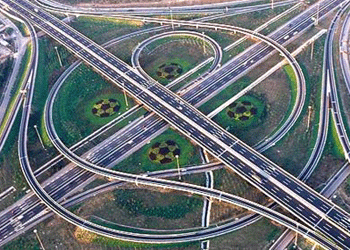
In major city roads traffic is often congested, even on the myriad of city ring roads (except those on the outer fringes of the city).
2 China National Highways
Beijing municipality is the only administrative unit where tolls are not charged for China National Highways. Elsewhere, though, these are toll roads on the national, and sometimes on the provincial level as well.
G-level (national) China National Highways are a pleasure to drive on. The speed limit is80 km/h(50 mph) but cars often zip at speeds over100 km/h(62 mph), thanks to the relative absence of speed detection cameras.
S-level (provincial) highways may be less smooth to drive on. Unlike national highways, sometimes there is no central reservation or road separation, and you may be limited to one lane per direction.
X-level (county) highways are not necessarily the worst to drive on, but they are challenging. More challenging are township-level highways.
3 Expressways
Expressways and express routes in China are a godsend, with traffic signs in both English and Chinese, emergency facilities, service areas, sufficient filling stations, plenty of exits, high speed limits, and the relative lack of traffic jams.
Although in English, both express routes and expressways are referred to as "expressways", Chinese counterparts are named differently. "Express routes" are written "快速公路", whereas expressways are written as "高速公路". The idea is that express routes liaise inside of cities and larger municipalities, whereas expressways do the national work, liaising from one centre to another.
Express routes have lower speed limits than expressways. In Beijing, a few expressways have speed limits below express routes: these are the Jingjintang Expressway (Beijing segment) and the Jingha Expressway (Beijing segment). They are clocked at 90 km/h(56 mph).