A new way to save heritage houses
 0 Comment(s)
 Print
Print E-mail Xinhua, October 30, 2017


|
|
|
Traditional lanterns glow near centuries-old residences in Hongcun Village, near Mount Huangshan, Anhui province, in May. (Photo:China Daily/Wang Hao) |
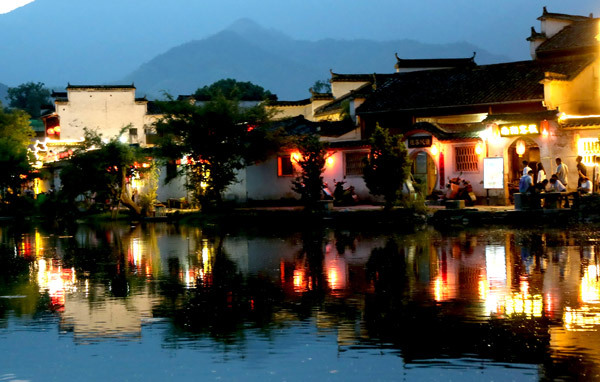
Faced with a lack of funds, one area is taking a fresh approach to protection
Old houses in Huangshan, Anhui province, offer a unique insight into the centuries-old architecture of the Ming and Qing dynasties, but a lack of funding is making protection a challenge.
There are more than 6,000 Ming and Qing houses in Huangshan, a UNESCO cultural and natural heritage site; but, because of limited government funding, fewer than one-fourth - 1,325 - are under State protection.
Yet, all of these old houses, many of which once belonged to important people, are treasures in local residents' eyes. How to effectively protect these examples of cultural heritage has long been a challenge for inhabitants and authorities alike.
Many villagers work in cities as migrant workers, leaving their old houses behind, vulnerable to decay and collapse.
"There is a lack of money for the renovation of these houses, and it is a real shame to have to watch them collapse or fall into ruin. So we are encouraging people who are able to invest capital in repairing the old houses to make good use of them," said Hu Jianbin, Huangshan's culture bureau chief.
Urbanization is a significant factor. Increasing numbers of city dwellers, tired of the hustle and bustle of city life coupled with traffic congestion and air pollution, are turning to the countryside to escape. Preservation of old houses in Huangshan offers such people a glimmer of hope.
Clean air
Huangshan has many advantages to attract people escaping city life. Apart from its natural scenic beauty, the city is one of the cleanest in China. Last year, the number of days that air quality reached the national standards of "excellent" and "fairly good" hit 355 in Huangshan. It is also the cradle of Hui culture, which has inspired unique residential building designs since the Song Dynasty (960-1279).
Shu Qing is one of the people attracted to Huangshan.
Born in Yixian county of Huangshan, Shu worked as a journalist in Beijing for eight years before returning to her hometown.
"I liked strolling around the Lama Temple in Beijing, and loved all the small restaurants nearby. I dreamed of opening one in my hometown," she said.
In 2009, Shu, left the big city and returned to Yixian where she opened her own restaurant - The Hui House - in an old building near the former residence of Sai Jinhua, a woman of note in the late Qing Dynasty (1644-1911). The building is located near the townships of Xidi and Hongcun, two UNESCO cultural heritage sites.


