Rustic villages nestle between terraced hillsides
 0 Comment(s)
 Print
Print E-mail Shanghai Daily, October 27, 2016


|
|
|
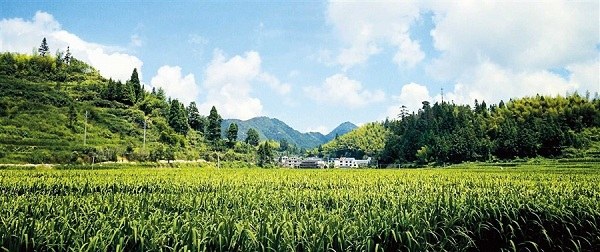
Wild rice shoots that flourish near Daji Township are an urban gourmet's delight.(Photos by Zhu Moqing) |
Leaving the August heat in Shanghai behind, I headed for the highlands of southern Zhejiang Province near the border with Fujian.
Hidden amid some of the highest mountains in East China are forests, lush valleys, ancient villages and wooden bridges — all in stark contrast to the ultra-urbanized areas of northern Zhejiang.
With the advent of high-speed rail service to the city of Lishui in the heart of southern Zhejiang, more people are discovering the beauty of this once less-traveled highland.
What I sought on my trip was not only the cooler weather and the natural wonders, but also the traces of history this corner of the province keeps secret.
Little Arcadia
Moving afield from Lishui is no easy traveling. Roads snake between mountains more than 1,500 meters high or through them in a chain of tunnels, some more than 5 kilometers long.
The last leg of my trip is over single-lane roads through a deep valley for more than an hour, with countless sharp bends to negotiate.
After climbing up to a 1,200-meter pass, the road gently slopes down and leads to a place unimaginable from below — a largely flat tableland the size of the West Lake of Hangzhou. Rimmed by peaks, it sits at an elevation of about 1,000 meters.
The altitude offers a refreshing retreat from the summer heat of the lowlands. The remote isolation of this place shielded it from history's wars.
A little Arcadia at first sight! That is my destination — Daji Township in Jingning County.
It is intriguing to contemplate the discovery of this geographic gem. Local chronicles state that the Mei family moved here from the lowland town of Yunhe in 1035 — during the Northern Song Dynasty (960-1127) — and found the place inhabited by the aboriginal She people.
But, at that time, it was no more than a swamp dotted with ancient woods. It was the Mei family who cultivated the land for farming and tamed the wilderness for homes.
Today, more than 3,000 people, most of them still surnamed Mei, live in the eight villages scattered around Daji. Rice paddies spread over the flatlands, and tea terraces are carved out of the surrounding hillsides.
Daji in local dialect means "big waterfall." The 70-meter-high Snowflake Falls is of little scenic interest today because the water is discharged from a reservoir with the press of a button. Upstream all the water has been diverted for irrigation. What makes this place special is a hidden little gem of ancient architecture.
Hidden temple
Nestled in a copse of bamboo and cedar near the center of the township are the remains of the historic Shisi Temple, including a Mahavira Hall and a wooden bell tower made in the ancient mortise-and-tenon style. Once used as a temple of mixed Buddhist and Taoist rites, the site originated from a more deep-rooted Chinese virtue.
According to Mei's family history, Mei Yuanxi, a 6-year-old boy during the Southern Song Dynasty (1127-1279), stood by his grandfather's tomb for three years without leaving. When Emperor Gaozong heard the story, he was so moved that he granted the title "Child of Outstanding Filial Responsibility" to the boy. The boy's father had built a hut for him to stay during the three years, so the emperor ordered the hut be named "Shisi Court." Shisi means "everlasting remembrance."
Due to the humid conditions of this typhoon-battered area, little of the original site survives today, except for a few trees that are as old as the story itself. Two 800-year-old cypress guard what was the entrance to the temple, and a lone, 1,500-year-old cedar stands proudly nearby.
The Mahavira Hall we see today began as a temple for ancestral worship by the boy's descendents, but the exact construction date is disputed. While the official records list it as being built in 1356, during late Yuan Dynasty (1271-1368), architectural experts argue that it is more likely to be a reconstruction in the Qing Dynasty (1644-1911). Regardless of its true age, the quaint style features many Song-era traits that are more commonly associated with a heritage architecture of northern China and even Japan. Such style is rarely found elsewhere in coastal Zhejiang today.


