Tianjin, thriving city of rivers
 0 Comment(s)
 Print
Print E-mail China Today, October 13, 2016


Tianjin is one of China's four municipalities directly under the jurisdiction of the central government. Located to the east of Beijing, it faces the Bohai Sea and is an international shipping hub at the economic center of the Bohai Rim. China (Tianjin) Pilot Free Trade Zone serves the whole of North China.
Tianjin's Dagu Port is at the mouth of the Haihe River, North China's largest water system, and upstream its five tributaries – the North Grand Canal, Yongding River, Daqing River, Ziya River, and the South Grand Canal – branch off. Tianjin's downtown area is located along the lower reaches of the Haihe River.
Tianjin is a city of distinct characteristics, most evident in the personality traits of its residents who imbue the rugged simplicity and innate passion of China's Northern culture. However, Tianjin also has the capacity for inclusiveness. The First Opium War of 1840-1842 forced the city to open to the outside world. This made it a center for cultural communications between China and the West, and a window for China to learn about Western culture. The resultant collision and blending of traditional culture with that of the West molded Tianjin's diverse milieu.
City Born of Rivers
The Grand Canal, built in the seventh century, has long been an important water route connecting Beijing and Hangzhou. It was integral to economic and cultural development and exchanges between China's north and south.
|
|
|
People enjoy the Haihe River scenery. |
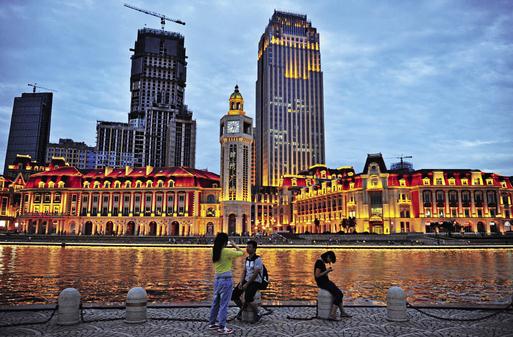
The section from Shandong's Linqing City to Tianjin's Sancha River Estuary, where the South and North Grand Canal and Haihe River converge, is known as the South Grand Canal. That running from Beijing's eastern suburb of Tongzhou to the estuary, Tianjin's cradle, meanwhile, is referred to as the North Grand Canal. Way back in the seventh century, China's central government set up an administration agency here. By the 13th century, the estuary had become a transit center for shipments of tribute grains. It included a special regulatory agency for supervision of salt production and sales.
In 1400, the Prince of Yan, Zhu Di (1360-1424), who later became third emperor of the Ming Dynasty (1368-1644), crossed the Grand Canal at the estuary to journey south and fight for the throne. To commemorate this war, on December 23, 1404, Zhu Di officially named the site Tianjin, which means "Emperor's ferry crossing." Owing to Tianjin's strategic military location, a fortress and barracks were built here and troops installed. This gave rise to the name Tianjinwei (wei means a military establishment), and the starting point of Tianjin's development.
China's southern and northern areas were unified once more after the 15th century. Tianjin's location, whereby both river and sea shipments could be conveniently transferred to the capital Beijing, made it a shipping hub for tribute grains. Before long it became the home of motley groups of boatmen, merchants, soldiers, farmers, and workers.


