Legends of Shanxi
 0 Comment(s)
 Print
Print E-mail China Daily, June 19, 2015


|
|
|
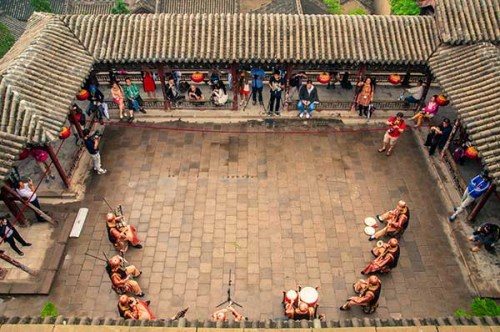
Being a cradle for the ancient Chinese civilization, Shanxi, just west of Beijing, is a gold mine of legends and folk tales.(Photo by Li Mengyuan/China Daily) |
There is a Chinese saying: "If you want to see the 30-year-old China, you should go to Shenzhen. For the 100-year-old China, go to Shanghai. Visit Beijing for 1,000 years of history. But to witness 5,000 years of history, go to Shanxi province."
Being a cradle for the ancient Chinese civilization, Shanxi, just west of Beijing, is a gold mine of legends and folk tales. The tales were composed through the centuries and passed from grandfathers to sons and daughters over countless generations. Today, Shanxi's local residents, with their trademark warm hospitality and kindliness, are always eager to share a story from the past — the past of a prosperous, wealthy and royal province.
Having hunted enough stories that were kindly narrated by the Shanxi television reporters and our charming guide during a trip for foreigners in May, I found that some of them sounded very familiar.
I believe no foreign student of Chinese language can escape being told the story of the obstinate Yugong, the one who moved mountains.
The origins of the story lie in Shanxi. In the northern part of the Taihang mountains, there lived a man called Yugong. His peaceful existence was disturbed by two soaring mountains, which stood before his house. Being a man of strong will, he determined to move the mountains stone by stone, and enlisted his family members, young and old alike, so all were involved in this work.
Yugong strongly believed in the success, notwithstanding being a laughing stock to his neighbors. He did not give up. His diligence and perseverance were discovered by God. The latter sent two angels to help Yugong. With the combined effort, the mountains were relocated, and ever since, Yugong's spirit has served as a standard of strong will and persistence in Chinese culture.
Another episode, perhaps more historical, tells of how one of Shanxi's renowned mountains came to be named for Emperor Wang Mang, an ambitious official of the Han Dynasty (BC221-207) who seized the throne.
Wang Mang has not been favored by historians because of his cruel policies and unpopular reforms, but he was a significant figure nonetheless.

Go to Forum >>0 Comment(s)