Attractions bloom on sacred mountain
 0 Comment(s)
 Print
Print E-mail Shanghai Daily, May 27, 2015


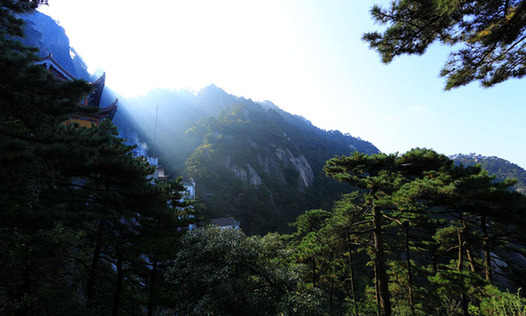
Located in Qingyang County in southern Anhui Province, Jiuhua Mountain is one of the Four Holy Buddhist Mountains in China.
Beautiful scenery and an agreeable climate makes Jiuhua Mountain Scenic Area a famous summer resort. The area has a subtropical humid monsoon climate with an average annual rainfall of 2,437 millimeters and temperature of 13.5 degrees Celsius. The best time to visit is from March to November.
Renowned as a sacred place for pilgrimage and a Chinese cultural heritage site, it is also known as “the most worshipped sacred place.”
The name “Jiuhua Mountain” means “the mountain of the nine lotuses.” An old Chinese saying goes that “a mountain is not famous for its height but for its holiness.” It is a holy land worshipped by pious pilgrims from all over the country.
There are 99 peaks and 18 scenic spots in Jiuhua Mountain. The highest peak is Shiwang at 1,342 meters, located north of Tiantai peak.
An old story goes that Li Bai, one of the most renowned poets of the Tang Dynasty (AD 618–907), visited the mountain and was so inspired by the spectacular scenery that he wrote a poem, setting it on the road to fame.
With many temples and monasteries, the mountain has a quiet and spiritual atmosphere. There are more than 90 temples, including the Incarnation Hall, Huacheng Temple, Zhiyuan Temple, Longevity Hall, Zhantanlin Temple, Ganlu Temple and Tiantai Zhending Temple, most of which were restored in the Ming (1368–1644) and Qing (1644-1912) dynasties.
Located in the center of Jiuhua Street, Huacheng Temple is the oldest temple on Jiuhua Mountain and has exquisite decoration. The splendid Incarnation Hall, surrounded by ancient trees, has a grand structure and is where Xinluo monk Jin Qiaojue was buried. A great number of visitors come here every year, paying homage to the great monk.
There are also many bizarre stones in the scenic area. Guanyin Stone on the Guanyin Peak, Wooden Fish Stone on the Shiwang Peak, Stone Buddha, and the stone of Monkey Paying homage to Guanyin.
The mountain also has a long history of producing tea such as Jiuhua Buddhist tea — also named Jiuhua Maofeng tea — as the fertile soil and moderate climate are suitable for tea planting.
Jiuhua Mountain is also famous for its vegetarian dishes, with many ingredients found naturally in its forest.

Go to Forum >>0 Comment(s)