How to raise a space explorer
 0
0 


|
|
|
Schoolchildren examine information about Mars on a giant cross-section of the planet at the Beijing Planetarium. [Photo:CRIENGLISH.com] |

|
|
|
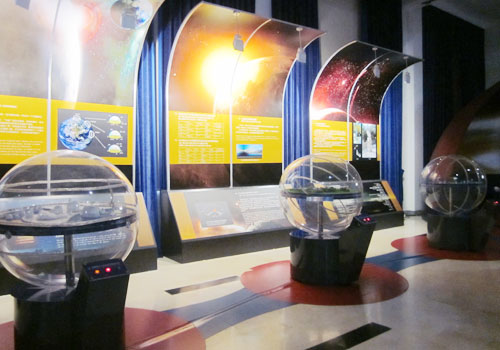
The Beijing Planetarium's exhibition halls combine moving models, displays, and short movies. [Photo:CRIENGLISH.com] |
With last year's successful launch of the Chang'e 2 lunar probe, China is quickly moving to the forefront of space exploration. Today's scientific knowledge and research ensure that the next generation of scientists will have the ability to pioneer space explorations. Curiosity about the cosmos starts at a young age, and the Beijing Planetarium helps that interest grow.
The planetarium seems to succeed at this mission; on any weekday, the Beijing Planetarium teems with young children, either on school field trips or with their parents. School children crowd around exhibits, trying to get the best view, and play with friends at interactive displays. Most popular, however are the theaters that attract long lines of students and families. The combination of traditional exhibition halls and advanced digital theatre technology keep the planetarium's information relevant in today's hi-tech society.
Steven Soong, director of the Beijing Planetarium's Digital Studio, noted that today's children are more impressed by movies. The planetarium's four theaters, built and modernized over the last decade, run programs that catch the audience's attention while introducing facts about the universe in a fun way. "We don't aim to let the children learn something, but to help them develop an interest in the cosmos and astronomy."
Different programs are aimed at different age groups. One features an old monk talking about the history of stargazing, while another takes children on a bumpy ride through outer space. Another popular program, aimed at children 4-6 years old, stars a popular American figure: Big Bird.
Big Bird and Elmo, from the American kids show, "Sesame Street" team up with Hu Hu Zhu, a character in the corresponding Chinese show, "Zhima Jie," for the program "One World, One Sky." The program is shown in Chinese at the Beijing Planetarium, and in English in the United States.
The three characters embark on a stargazing adventure in the US and China, noting how we all see the same sky and constellations and help audiences spot the Big Dipper and North Star. Some differences are talked about: Big Bird tells the audience about the cow who jumps over the moon in an English nursery rhyme and Hu Hu Zhu responds with the Chinese story of Tu Yeye, a rabbit who lives on the moon.


