Tales from Turpan
 0
0 


|
|
|
Ruins at the ancient city of Gaochang. Photo: A Takhtani Agnihotri |
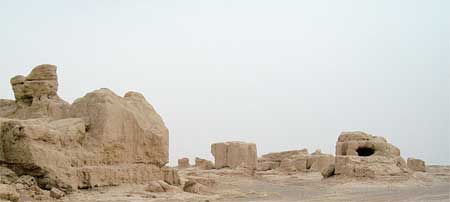
Long after I had arrived home to the snug familiarity of Shanghai from the dusty and challeng-ing desert basin of Turpan, my revelation came. Often described as one of the most inhospitable terrains in the world, marked with miles of gritty sand dunes, fiery rock formations and a drab flatness, Turpan reminded me of none of these elements. As I sat to reflect on my holiday in Western China, all that this small Silk Road post had imprinted in my mind was colors and more colors.
An endless swathe of land that gets about 3,200 hours of sunshine every year, about 1,000 hours more than other Chinese regions at the same latitude, Turpan is full of surprises.
From Uygur women in traditional dress and enjoying a Kazak family's yurt, to the courtyards of grape farmers in small villages, the vibrancy of the culture and surrounds far outweigh the harsh environment of this land. Perhaps, where nature missed, culture filled in.
|
|
|
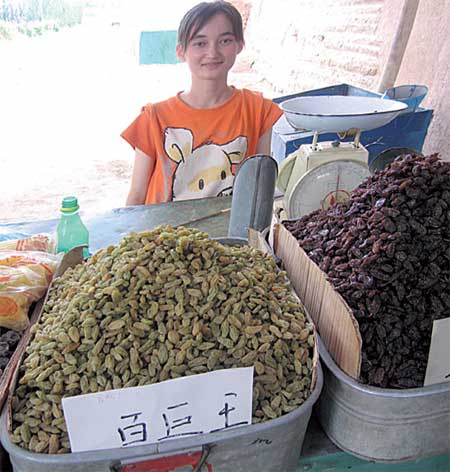
A Uyghur local selling giant raisins produced in Turpan. Photo: Peter C. Espina. |
On the Silk Road
Turpan, also known as Tulupan in Chinese, is a good 150 kilometers southeast of Urumqi and although the roads resemble the best of highways, the journey can get risky because of sandstorms. Our guide, a Uyghur local, sounded a stern note about the dangers of the sandstorms that spring out of the Gobi Desert with little warning. Nodding our heads we could hardly conceal our shock as our car was hit on the way to our destination. Wind speeds of 70-80 kilometers an hour rocked our little vehicle. Silent glances were exchanged between the three members of my family. Our driver Shen said we were a group of sturdy Indians. Only we knew the truth.
In between this hugely moving (literally) experience, our guide filled us with interesting details about the vast expanse of the remote oasis town, situated on the northern part of the Silk Road where traders rested on their way. In those days, the Silk Road depended upon a line of strategically situated oases that hugged the perimeter of the desert. Although Turpan is one of the lowest places on Earth, with minimal levels of rainfall, it was once referred to as "a green island in the sandy wilderness," by travelers in the 1920s.

Go to Forum >>0 Comments