For all the tea in China
 0
0 


Nowadays, who drinks tea? Back in North America or Europe, generally our parents'generation drank tea. It was Indian tea, strong and black in color. Some drank it white and sweet, some black with lemon, some straight out of the kettle, boiled over an open fire so it had the taste of smoke and gum leaves. The younger generation is more likely to drink coffee or fruit and herbal teas. But many do not realize there are so many different varieties of Chinese tea which makes it an integral part of Chinese culture.
In my time here, I have learned to love tea and one of my favorite activities is to hit the tea markets and spend all day there, chatting to the tea sellers, sipping different teas, drooling over the beautiful teapots and trying to decide what to buy, and how much my wallet can stand getting lighter.
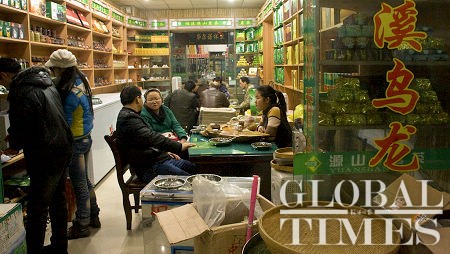
Little tea shops are lovely places to start learning about tea. My favorite small tea shop owner, in the Muslim Quarter in Xi'an, is happy to spend time chatting with me about tea. His family comes from Fujian, so he heads back home each spring to buy wonderful new teas. He sells aromatic teas as well – chrysanthemum, jasmine, rose, lychee and pear teas, all lovely tasting and fragrant teas. I can buy 'proper' tea here too – pu'er, oolong, tieguanyin, longjing and many others.
|
|
|
The tea shop. Photo: Deborah Howard |
Fancy tea shops also abound, and in these, the art of tea is as important as the taste. Here, invariably the beautiful girl serving you tea will be dressed in traditional costume, she will sit or kneel before you at a low, highly decorated, ornately carved table, and with graceful gestures pour tea into your thimble-sized cups. A traditional musician may be playing nearby to enhance the atmosphere.
There is a touch of snobbery around tea, just as there is around wine or olives or cheese back home. 'real' tea isn't fruit- or flower-flavoured. 'real' tea relies on the mountain it is grown on, the water used to grow the tree, the age of the tree, the time of the year the leaves are picked and many more things aficionados talk about for hours.
|
|
|
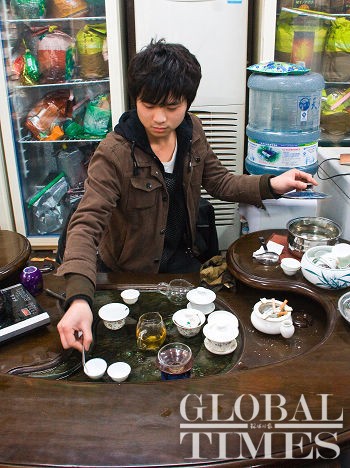
The man is making tea. Photo: Deborah Howard |
To appreciate 'real' tea you must head for the tea markets. I have two that I regularly visit in Xi'an. The first one is on Wen Yi Nan Lu (文藝南路), a large building housing maybe 90 or so shops, some selling tea, others selling the special pots, cups, tools and implements that accompany the art of making tea. The second market, Yiwu Tea Street on the western side of the city is enormous – a city block of buildings with two or more floors, all dedicated to all things tea. The shops here specialize in different types of tea, so one shop will have many different pu'er or dried cakes of tea leaves, another will give you a number of different types of tieguanyin tea.


