Top 10 most endangered animals in China
- By Yang Xi
 0 Comment(s)
 Print
Print E-mail China.org.cn, February 8, 2012


 Tibetan Antelope
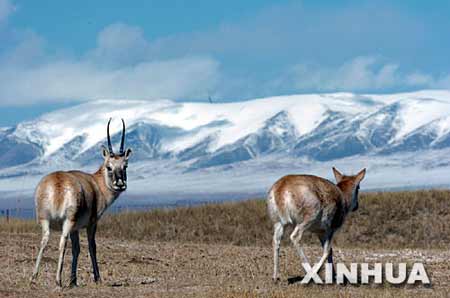
The Tibetan Antelope belongs to the Bovidae family of Artiodactyla order. Weighing up to 45 to 60 kilograms, it has a sturdy body, with a wide and long head and stout mouth. Its nasal part is wide and slightly ridged. It has a short tail but has strong and well-proportioned limbs. Except for the cheek, it is covered with bushy, soft and dense hair, making the body hazel. Interestingly, it holds its head high when its walking. Male antelope has a long, straight and shiny fuliginous horn, commonly 60 centimeters in length. The female antelope is hornless.
Status:
In 1996, the Tibetan antelope was listed as "vulnerable" by International Union for Conservation of Nature and Natural Resources (IUCN). This listing was upgraded to "endangered' in 2000. The species has also been listed on Appendix I of the Convention on International Trade in Endangered Species of Wild Fauna and Flora (CITES) since 1979. There are estimated about 100,000 Tibetan Antelopes in China.
Geographic Distribution:
A Chinese survey found that the distribution density of Tibetan Antelopes, also known as chiru, in the southwest of Qinghai Province in 1986 was 0.2 to 0.3 head per square kilometer. The herds numbering more than 2,000 could be found in 1991 in the east of the Changtang Nature Reserve. In 1994, the estimated number of Tibetan Antelope inhabiting the Kunlun Mountain area was about 43,700. In recent years, nobody has seen them in herds of 2,000.
You may not know:
Tibetan antelopes usually inhabit on tablelands with an elevation of 3,400 to 5,500 meters, often moving on grasslands near water in the morning and at dusk. Male and female antelopes usually live in different groups of 2 to 6, or even tens or hundreds. It is born coward but alert, with sensitive hearing and vision ability, and usually appears in remote and unapproachable places. It migrates for long distances seasonally, feeding mainly on grass plants and sedge plants. The estrous period is in late winter and early spring, when male antelopes fight fiercely for female antelopes. A family is usually composed of one male antelope and several female antelope, and only one baby per propagation.

Go to Forum >>0 Comment(s)