The power politics of Europe and the United States
- By Heiko Khoo
 0 Comment(s)
 Print
Print E-mail China.org.cn, April 17, 2016


|
|
|
Countdown [By Zhai Haijun / China.org.cn] |
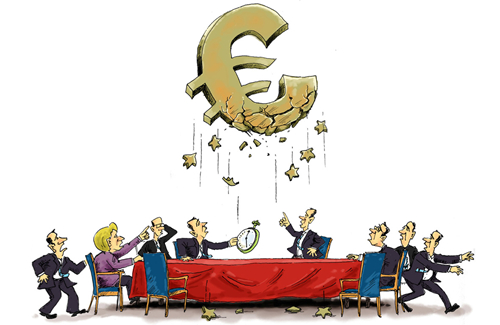
If the European Union was a nation it would have the largest economy in the world; but a century after the First World War, can Europe produce enduring prosperity and permanent peace? Over the last five centuries, European states unified the world under their dominion but internal conflicts and contradictions dominate European history. And the 52 sovereign states of Europe are divided by geographical complexities and long-term historical conflicts that are sporadically reawakened and undermine prospects for unity.
Norman Angell's 1910 book, "The Great Illusion," argued that the integration and interdependence of Europe would prevent future wars. However, between 1914 and 1945, wars and political conflicts killed 100 million Europeans. From 1945 until the early 1990s, the continent was occupied by the Soviet Union and the United States. This maintained a peaceful balance of power based on the fear of a nuclear war - driven by the conflict between contradictory socio-economic systems. At that time, the idea of a unified Western Europe was supported and promoted by the United States.
After the collapse of the Communist-led governments in Eastern Europe and the former Soviet Union, members of the European Union signed the Maastricht Treaty in 1992. It was designed to foster prosperity and to draw new European states into an ever-closer union.
However, the United States orchestrated a number of so-called "color revolutions" in Ukraine, Georgia, and other new countries surrounding Russia. In 2008, the Russian invasion of Georgia showed that Russia would not take this encroachment into their previous spheres of influence lying down. When the 2008 economic crisis struck, it shattered illusions of economic stability and competence in Western capitalism.
Europeans lacked a concentrated and unified means of interstate decision-making to contain and control the crisis. This is largely because the interests of different European capitalist states conflicted with each other.
Germanic political and economic structures are based on a different model than U.S. capitalism. Indeed, the Germanic and American models can be seen as two basic but distinct types of capitalism, the Germanic variety being more controlled and interventionist and the U.S. variety being more closely aligned to free market philosophy.


