What does the US-Cuba reconciliation mean?
- By Wei Hongxia
 0 Comment(s)
 Print
Print E-mail China.org.cn, July 24, 2015


|
|
|
Together at last [By Zhai Haijun/China.org.cn] |
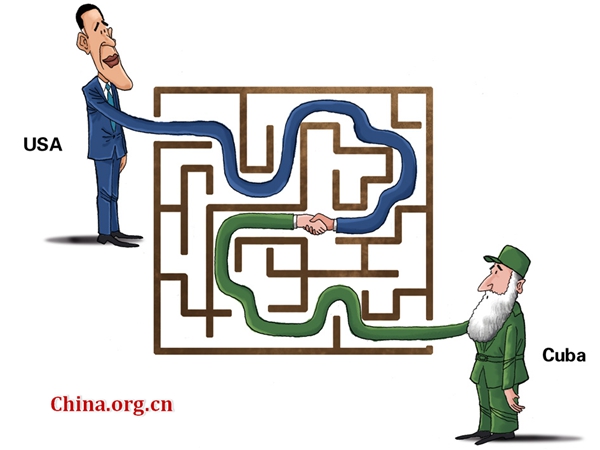
With the flag of Cuba raised in Washington, the restoration of diplomatic relations between the United States and its arch-enemy Cuba was completed on schedule on July 20, 2015.
On December 17, 2014, with the release of Alan Gross, an American worker who was jailed in Cuba for years, U.S. President Barack Obama and his Cuban counterpart Raul Castro activated moves to normalize diplomatic relations between the two countries, saying they would chart a new course. This is the most profound change in relations between the United States and Cuba in decades. It absolutely has meaningful implications for both countries, Latin America and the world.
The image of the United States was enhanced with admitting the failure of comprehensive punitive sanctions against Cuba, an island nation so close to the U.S. mainland. This serves to strengthen American soft power in the region, which has eroded in the past decade. For President Obama, this breakthrough deal with Cuba will no doubt be a remarkable legacy in his foreign policy. The business circle, which has had its eye on Cuba's investment opportunities, is applauding such a bold step by the U.S. administration.
The most important thing is that the reconciliation inspires hope on both sides of the Florida Straits that the livelihoods of millions of immigrants from Cuba to the United States will be improved. Despite the decades-long estrangement with Cuba, U.S. immigration policy treats migrants from Cuba differently from migrants from any other country. Cuban immigrants are easily admitted to the United States, and may apply for legal permanent residency one year later if they meet refugee requirements. The current Cuban immigrant policy of the United States will likely change as the two countries have reestablished their relations.
For Cuba, which has been seriously affected by the U.S. embargo, a series of new measures by the U.S. will have an impact on its economy and the lives of many Cubans. The amount of money which can be sent to Cuba in remittances will increase by four times, and this will help to improve the lives of thousands of Cuban families. Travel restrictions to Cuba will be eased, which will make Cuban's family visits easier; and telecom providers from the United States will be allowed access to Cuba's infrastructure, which will make the internet accessible and affordable for more Cubans.
For the region, the restoration of relations with the United States means that Cuba, after decades of isolation, will become an integral part of the region and will be able to play a full role therein. With Cuba's participation in the Hemisphere Summit, this change creates a space for the United States to engage more productively with Latin America on a broad agenda, including on the key summit topic of human rights, as well as on global competitiveness, energy and the environment.


