Transparency in military capability and strategic intent
- By Fan Jishe
 0 Comment(s)
 Print
Print E-mail China.org.cn, May 29, 2015


|
|
|
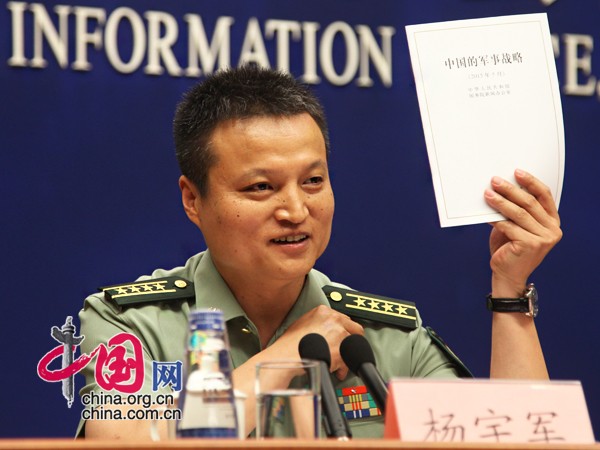
Sr. Col. Yang Yujun, spokesman for the Ministry of National Defense (MND) of the People's Republic of China (PRC), briefs on China's first white paper on military strategy and answers reporters' questions on May 26, 2015.Spokesperson of Chinese Ministry of National Defense Senior Colonel Yang Yujun holds a copy of the annual white paper on China's military strategy during a news conference in Beijing, China, May 26, 2015 |
On Tuesday, May 26, China issued "China's Military Strategy." This is the ninth official white paper on China's national defense to be released since the inaugural report was issued in 1998. This year's white paper further explained China's view of the national security environment, the missions and strategic tasks of its armed forces, the strategic guidelines for its active defense strategy, and the process through which China builds, develops, and deploys its armed forces. The publication of official documents is common practice in the pursuit of military transparency, which is China's goal in publishing this white paper.
Transparency is a term frequently used when assessing one country's military capability and strategic intent. However, one can tell from the news reports, commentaries, and analyses published immediately after the release of this white paper that transparency is a pretty tricky term. First, the term transparency originated either in domestic political processes, e.g., the national defense authorization process in the United States, or from treaty obligations, e.g., the bilateral arms control and disarmament treaties between the United States and Russia. Thus, transparency has mostly been a by-product or a reciprocal outcome of a wider process with a primary goal other than transparency. In China's case, the country has no such incentive or obligation to be transparent either about its military capabilities or its strategic intent. Other countries, big or small, are not entitled to demand Chinese military transparency.
Second, the concept of transparency can be misleading when it is taken at face value. For example, in the case of the United States - whose military budget is as big as, if not bigger than, the combined military budgets of the next 14 top-spending countries - military transparency does not overshadow the fact that the United States has the world's most fearsome military capabilities and frequently interferes in other countries' internal affairs. China might not be as transparent as it is supposed to be, but that does not mean that China's military is more powerful than that of the United States or that China intends to destabilize the regional security architecture.
Third, what makes transparency even trickier for China is that military transparency seems to be a double-edged sword. When China was not very transparent about a decade ago, China was criticized for being threatening only because it was not transparent. Now that China is becoming more and more transparent about its military capabilities and strategic intention, China is once again being criticized for being threatening only because it has acknowledged and explained its strategic guideline of "active defense" and its plans to build, develop, and deploy its armed forces. It is not difficult to find overreactions, over-interpretations, misperceptions and distortions among commentaries on and analyses of China's latest white paper.


