China's economy in a global context
- By Zhang Lijuan
 0 Comment(s)
 Print
Print E-mail China.org.cn, January 23, 2015


The National Bureau of Statistics of China has released key figures for measuring the Chinese economy in 2014. As expected, China's growth rate as measured by GDP was 7.4 percent, the lowest since 2002. Over the past 15 years, China's average annual GDP growth was 8.9 percent. The size of the Chinese economy has increased from RMB 8.94 trillion (US$1.43 trillion) in 2000 to RMB 63.64 trillion (US$10.18 trillion) in 2014. This means China's economy is seven times larger than it was in 2000. China has created a true economic miracle.
|
|
|
Chinese Premier Li Keqiang delivers a keynote speech at the World Economic Forum (WEF) annual meeting in Davos, Switzerland, on Jan. 21, 2015. [Photo/Xinhua] |
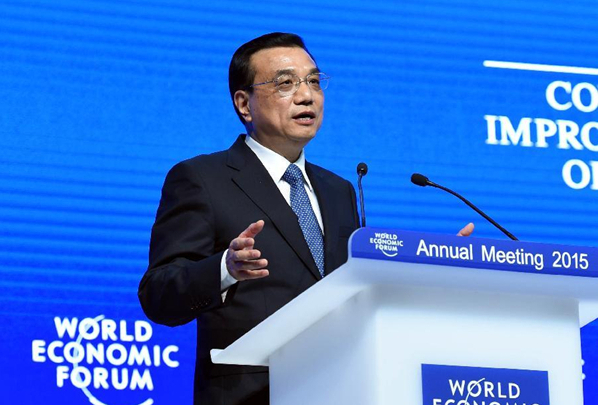
But the slowing of the Chinese economy is not a new story. Rather, a gradual slowdown is part of the plan, as Premier Li Keqiang said at the World Economic Forum in Davos today. China's GDP growth rate began single digit expansion in 2011. For years, scholars and researchers all over the world have had serious discussions about how sustainable China's economy is and how far it may go before a hard landing. Premier Li reassured us that China will not experience a hard landing although the dangers in the Chinese economy have been well recognized, risks in the real estate and financial sectors chief among them. Expanding local government debt and the emerging shadow banking industry have also garnered strong warnings from critics. Such risks still exist, and, if anything, have worsened. To deal with these dangers, the Chinese government has prepared to accept the next stage of China's economic development - the "new normal," which basically means accepting slower growth within a better growth structure and faster, consumption-driven economy.
Today, it is very difficult to judge the Chinese economy based solely on domestic factors. This is because the Chinese economy exists and operates in a wider global context or a "new global context." This is a new experience for China. The world economic scenario has changed dramatically since the 1990s, and the current economic climate is not even similar to that of the 2000s. New challenges and conflicts are borderless but remain connected in a global value chain. A misstep in one nation's economy can quickly spread to that of another to potentially end an era of economic integration and global growth.
The world's leading economies have to face the following common challenges and conflicts in a new global context: the conflict between national interests and global governance, the conflict between domestic political interests and economic logic, the conflict between regional and multilateral free trade approaches, and the conflict between domestic economic growth and global climate change.


