Will climate commitment constrain China’s economic growth?
- By Qi Ye
 0 Comment(s)
 Print
Print E-mail China.org.cn, January 20, 2015


|
|
|
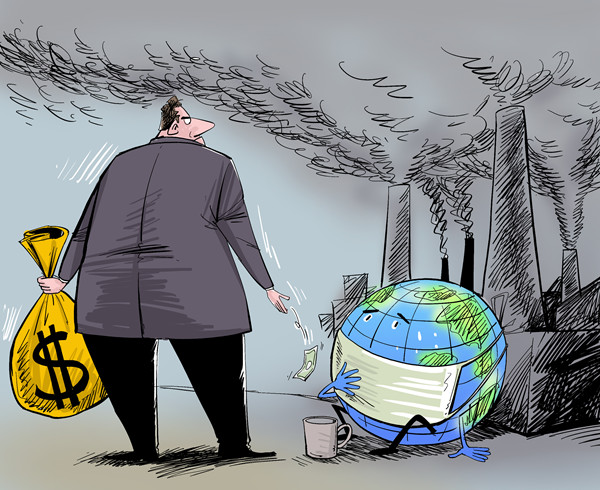
Cut the cost [By Gou Ben/China.org.cn] |
On 12 November 2014, President Xi Jinping held formal talks with visiting U.S. President Barack Obama and later they signed a surprising and inspiring China-U.S. joint statement on climate response and clean energy cooperation. By around 2030, according to this statement, China's carbon dioxide emissions are expected to peak, and the proportion of clean energy in its primary energy consumption will increase by 20%. Though this is not yet a formal commitment, it should be regarded as a major step toward that goal and an ambitious plan. People may ask if this goal can be reached and if the commitment will constrain China's economic growth.
Such concern is justifiable, as this is a fairly aggressive objective which moves up the peak time by 5 to 10 years. And whether climate response affects economic growth is not a new topic. President George W. Bush pulled the U.S. out of the Kyoto Protocol right after he took office as president, precisely because he was concerned about the economic implications of climate response.
There is indeed a close link between carbon emissions, energy consumption and economic growth. In this industrial age, carbon emissions are the sum of carbon dioxide emissions mainly caused by the use of fossil fuel. Generally speaking, the carbon emissions of an economy are proportionate to the level of its economic development, hence the higher per capita carbon emissions of developed countries than developing ones. Take China for example. In 1980 when its reform and opening-up program was launched, its per capita carbon emissions were 1.47 tons, which more than quadrupled 32 years later, standing at 5.52 tons in 2012. In the same period, China's GDP almost registered a 20-fold growth, increasing by about 10% annually. This speaks to the close connection between China's fast economic growth and the surge of its carbon emissions. If China's carbon emissions are to peak in 2030, its economic growth will have to slow down.
The relationship between economic growth and carbon emissions often relies on two factors. One is energy intensity, or energy consumption per unit of GDP growth; the other is carbon density, or carbon dioxide emissions per unit of energy consumption. The carbon emissions of a country are therefore determined by its GDP, energy intensity and carbon density. Changes of any of these factors will affect carbon emissions. For instance, the sharp drop of China's energy intensity in recent years has put a brake on the increase of its carbon emissions, and the U.S. shale gas revolution, which uses natural gas to replace coal for electricity generation, has significantly reduced the U.S. carbon density and greenhouse gas emissions. In a sense, the changing rate of carbon emissions can be roughly counted as the sum of the changing rates of GDP aggregate, energy intensity and carbon density.


