China's unique approach in the Middle East
- By Jin Liangxiang
 0 Comment(s)
 Print
Print E-mail
China.org.cn, August 30, 2011
E-mail
China.org.cn, August 30, 2011


|
|
|
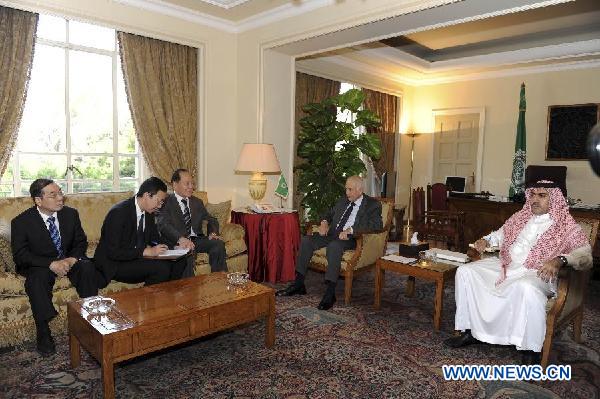
Chinese Middle East envoy Wu Sike (3rd L) talks with Arab League Secretary General Nabil el-Arabi (2nd R) at the Arab League Headquarter in Cairo, Egypt, August 28, 2011. [Xinhua/Li Muzi] |
There is a kind of visible dissatisfaction among American scholars about Beijing's role in the Middle East. It might be true that in the past decades, China has not played the role as expected by the U.S. and the West, and that could be the logic and reasons behind the Americans' frustration about China's "poor" attitude for cooperation in the troubled region. However, China's contribution to the region both in aiding in humanitarian efforts and assisting in infrastructure construction should not be ignored, and China's approach toward the region to distance itself from the West's ideology-based agenda should not be misrepresented.
For Americans, cooperation largely means voting for UNSC resolutions leading to sanctions and even military actions against major Middle East "rogue" states. In other words, China is expected to either provide support or help to lay legitimacy in the U.S.'s interventions in the Middle East's regional affairs.
Ideology and geopolitics are the two major factors directing the U.S. strategy in the Middle East. But ideology is always used as the means or the ends - or both - in its Mid-East policy. When George W. Bush was president, ideology had been the top if not sole factor in his administration's Middle East policy, as is witnessed in the two military actions to promote democracy.
Barack Obama's administration has slowed down such steps, and it has especially taken a discreet and more prudent approach regarding the Middle East anti-establishment movements of 2o11. Yet, it is nothing different from its predecessor in promoting democracy as defined by western culture and values, which has been suitable for its own style of development.
The competition of ideology and its influences ended with the Cold War, both artifacts of a previous century. By contrast, China is a much more pragmatic international actor, and it is highly unlikely to either promote its own ideology on the world stage or support others in such endeavors. By such measure, China can be of little help if the U.S.'s maintains a top priority to promote its ideology, and it is rather unreasonable that the West should criticize Beijing for withholding support.
Each culture has found its own values in globalization and modernization. Democracy might be suitable for the West, but not necessarily so for other parts of the world. Recent global financial crisis has made it evident that the West's system is far from perfect. There is nothing wrong with the West cultivating democracy in its own backyard, but it is quite another thing to impose their values on countries which have no such political tradition.


