Where is the way out for rural students?
- By Xiong Bingqi
 0 Comment(s)
 Print
Print E-mail
China.org.cn, August 11, 2011
E-mail
China.org.cn, August 11, 2011


|
|
|
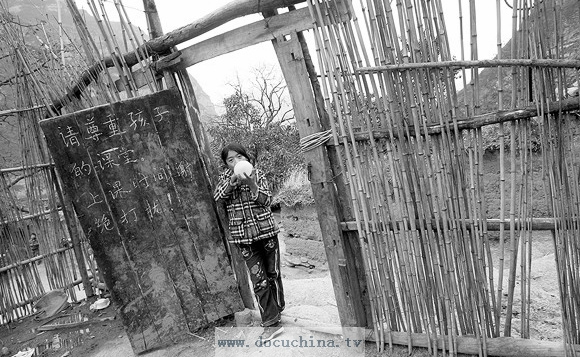
Gulu Village School, Sichuan Province [By Wen Huan/Southern Weekend] |
The declining proportion of rural students to urban students in universities is becoming increasingly alarming. A sample survey of undergraduate students entering Tsinghua University's School of Humanities last year showed that rural students made up only 17 percent of the class, even though rural students accounted for 62 percent of students who took the 2010 national college entrance exam.
This trend is only evident in top universities. Overall, the number of rural students attending universities is on the rise, representing 43.4 percent of first-year students in 1989 and 53 percent in 2005. But most of them are going to second- and third-tier universities or vocational colleges. Rather than focusing on closing the proportional gap between urban and rural students at top universities, China should focus on improving the "return on investment" at second- and third-tier universities – that is, strengthening the quality of education at those schools.
Currently, China invests more in top universities, which keeps their tuitions low. Tuition fees at Peking and Tsinghua universities are among the lowest nationwide. But many private vocational and junior colleges have no access to state investments, subsidies or social donations and instead rely solely on tuition fees. Thus, such schools can be very expensive.
The problem is further compounded by employers' preference for graduates from Project 985 universities. (Project 985 refers to a program begun under former President Jiang Zemin to promote China's higher education system in 1998, which sponsors 39 of China's most elite universities.) Such a requirement hinders the development of graduates of other schools. So while relatively affluent urban children have more access to the nation's prestigious institutions with a minimal investment for a greater return, poor rural children are paying more to go to a general school for a lower return.
This paradox can only be solved by eradicating unfair policies and systems. The government should provide equal chances for universities. In other countries, world-class universities are not created through government projects, but through fair and free competition. To ensure the healthy development of higher education in China, unequal systems imposed on schools must be canceled so that they can compete as equals.
The declining proportion of rural students in universities is a symptom of unfair competition in China's education. Under the planned, hierarchical system, the road to top universities will become narrower. Therefore, it would be of no avail to discuss the percentage of rural and urban students in top universities. Only by eliminating the current unfair policies and systems can China find a way out to promote quality-oriented education. It is also the way out for rural students.
(This post was first published in Chinese and translated by Li Huiru.)
Opinion articles reflect the views of their authors, not necessarily those of China.org.cn


