The great tax debate and runaway inflation
 0
0 


|
|
|
[By Zhou Tao/Shanghai Daily] |
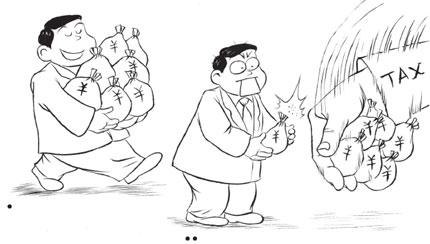
AN online posting illustrating a wealthy man going broke after paying taxes and insurance has gone viral in China and sparked a public debate.
The posting says that someone who earns 10,000 yuan (US$1,527) a month may only have 4,400 yuan left after paying various taxes and welfare insurance costs. It has been reposted more than 10,000 times on popular microblogging website t.sina.com.
The post is clear: Taxes have become a great burden at a time of runaway inflation, a sentiment echoed by numerous Internet users.
However, tax experts have analyzed the posting and say that it doesn't quite add up. According to Su Ming, deputy head of the Research Institute for Fiscal Science under the Ministry of Finance, income taxes for a 10,000-yuan monthly salary come to about 780 yuan. After subtracting pension payments, about 7,000 yuan remains, Su says.
If the entire 7,000 yuan were spent on cigarettes, the most heavily taxed commodity, the person would have to pay 3,918 yuan in consumer taxes. Even in this extreme case, the total taxes paid remain under 4,700 yuan, Su said. "The calculations are wrong. But the post shows that people are getting more anxious about taxes, which they don't actually know much about," he said.
In China, employers automatically deduct income taxes from their workers' salaries. "The upside of this arrangement is that it saves trouble for the workers. The downside is that a lot of people have little idea about how much taxes they are paying," said Huang Pingbo, an official from the tax bureau of southern city of Shenzhen.
Shenzhen issued 2.19 million "tax-paid" certificates in 2010, six times more than in 2009. The certificates confirm that the recipient has paid taxes for the year, allowing taxpayers to see just how much they're paying.
"Before 2010, those certificates were only given to places of work, and tax authorities only held those workplaces accountable. Now, everyone is taken into account," Huang said.
"Now I know how much taxes I've paid. More important, I feel respected as a taxpayer," said Zhang Shang, an employee at a local IT company.


