Early RMB revaluation would hurt the world economy
 0
0 


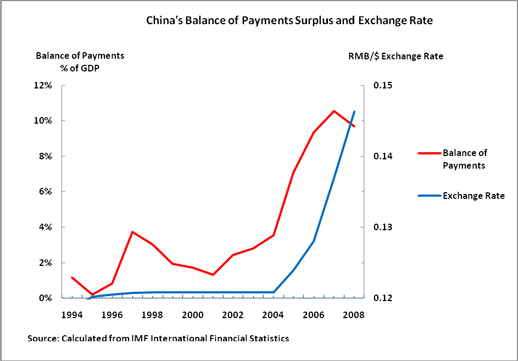
Over such a short time frame, we do not need to rely on theoretical models. The effects of such a revaluation have been seen in practice. Zhong Shan, China's commerce vice minister, noted: "From 2005 to 2008, the RMB appreciated by 21 percent against the dollar but China's trade surplus with the U.S. increased by 20.8 percent annually. Since 2009 the RMB exchange rate has remained basically stable, but China's surplus with the U.S. has fallen by 16.1 percent."
What occurred in 2005 to 2008, when China increased its exchange rate, is shown in Figure 3. This illustrates that over a three year period as the RMB's exchange rate increased China's trade surplus did not shrink. On the contrary, it rose.
The fundamental reason is that, as discussed in an earlier column, China's imports are in large part inputs into exports and therefore imports and exports do not move separately.
But even ignoring this fact, there is a well established short-term "J curve" effect regarding currency changes. When a currency's exchange rate changes, it takes time for demand to adjust. Revaluation increases export prices and reduces import prices and the "J curve effect" of an RMB revaluation would increase China's trade surplus in the short term. But even a short term increase in China's trade surplus would reverse the most significant source of world demand and deal a blow to the world economy as it struggles out of the financial crisis.
Timing is crucial for the world economy. In the medium to long term the exchange rate of the RMB should and will go up – the increasing productivity of China's economy makes it competitive at progressively higher exchange rates. But because an increase in the RMB exchange rate would put upward pressure on China's trade surplus in the short term, from the point of view of world trade it would be better if revaluation did not take place until the world recovery is more firmly established – on current trends likely to be closer to the end of this year.
Holding the RMB's exchange rate steady in the short term, while letting it rise in the medium/long term, has so far been the position of China's government. But it also happens to be in the best interests of the world economy.
The author is a columnist with China.org.cn. For more information please visit: http://m.shenbo75.com/opinion/node_7080931.htm


