Trade protectionism behind Google's pull-out
 0
0 


On January 12, Google posted an article in its blog, announcing a possible pull-out from China. The next day US Secretary of State Hilary Clinton responded to Google's announcement while on an official visit to the South Pacific. In her statement, Clinton said that the U.S. is "looking to the Chinese government for an explanation." On January 21, Clinton delivered a speech on "internet freedom", in which she reiterated her concern over the matter and called for China to lift restrictions on citizens' use of the internet. The Chinese government slammed Clinton's remarks the following day.
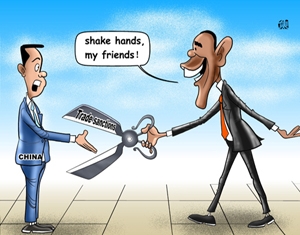
Google's threat to pull out and the resulting heated worldwide discussion demonstrated the political interests, trade frictions and cultural conflicts between China and the U.S. However, there is more for us to think about with the Google incident. The U.S. once again resorted to trade protectionism. And this time it is the emerging sector of internet rather than a traditional manufacturing sector that turned to the US government for protection.
 |
| [By JiaoHaiyang/China.org.cn] |
Given that internet companies have an important place in the US economy; it's natural for the White House to support their development. According to research by Harvard Business School and Hamilton Consultants, advertising-supported internet economy represents 2.1 percent of the total US GDP. Internet companies employ about 1.2 million Americans to engage directly in advertisement business, and the construction and maintenance of infrastructures. The internet industry contributes US$175 billion of direct economic value, including US$20 billion from advertisement services, US$85 billion from retail trade and US$70 billion of direct payment to internet service providers.
Just like other large multinational companies, US internet companies looked to overseas markets as they sought for further development. However, nearly all of them were challenged by strong local competitors in the Chinese market. Domestic internet companies, represented by Baidu, Dangdang, Sina, Tencent and Taobao, have put great pressure on the multinationals. Furthermore, China's internet companies have been nurturing their own customer base since the 1990s, a time when their US counterparts haven't yet noticed the huge potential of Chinese internet users. Therefore when US internet firms entered China, the country's internet market has basically been divided up by local operators.


