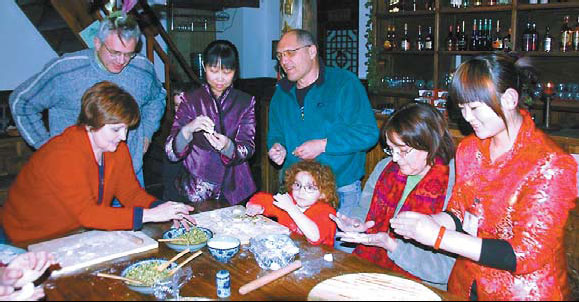
Ambassador Amos Nadai (fourth from left)
getting a taste of traditional Chinese culture at a dumpling-making
session with the locals. Courtesy of Amos Nadai
I came to Beijing six months ago with an image of China that was
based on a lot of reading about China since my early childhood, on
meeting with Chinese colleagues and visitors to Israel and on very
few short visits to China.
I knew that China had entered the 21st century as one of the
strongest economic powers and I knew that the big Chinese cities
reflect the great success of this country.
And yet, during the six months of my stay in China, while
wandering below the super modern towers of Beijing I was wondering
where I would be able to see and experience the rural China I
imagined as a child.
I spent the Spring Festival together with Israeli friends in
Pingyao, Shanxi province. On the way there we stopped at Qiao's
Courtyard, northeast of Pingyao in Qixian county.
The courtyard was the residential house of Qiao Zhiyong, a
wealthy gentleman in the Qing Dynasty (1644-1911), who attained his
fortune in financial and commercial business in the periods of
Emperor Jiaqing and Emperor Daoguang. With architectural
characteristics typical of northern China, the courtyard is divided
into six big yards and 20 small yards with 313 rooms and covers an
area of more than 8,700 sq m.
No wonder director Zhang Yimou chose it for the location of his
film Raise the Red Lantern. We walked through all the yards and
enjoyed the beautiful garden. As it was late afternoon on Chinese
New Year, we were alone and felt like walking back in time. We
could almost hear the beautiful music composed for the film by Zhao
Jiping and imagine people's life hundreds of years ago.
Upon arriving in Pingyao, I immediately realized that the
atmosphere of old China is preserved in this wonderful place. We
walked for three days in the small alleys and in the courtyards. We
were invited to people's homes where we warmed up from the freezing
cold and enjoyed their hospitality. None of us spoke fluent
Chinese, but language did not create a barrier - they told us about
the festival and we told them about Israel.
The atmosphere of the Chinese Spring Festival very much reminded
me of our Jewish holidays. We too like to gather our families; we
spend time together, invite friends and guests, eat, drink, sing
traditional songs and tell stories.
Another thing that reminded me of Jewish tradition was the
reference to the importance Chinese people (in olden times as
today) attach to education.
In the big courtyard of the Wangs' (a rich salt merchant who
built a compound of 34,450 sq m 50 km north of Pingyao in Lingshi
county), we saw several courtyards that used to be the different
schools for the younger generation and a museum dedicated to the
civil service examinations of the period.
We also visited the Pingyao Confucius Temple. The temple has
China's largest statue collection of Confucius and famous ancient
Confucian scholars, and it was used as a campus for the Pingyao
Middle School from 1949 until 2003.
Our best recollection from Pingyao will be associated with our
accommodation. We spent four days as guests at Tianyuankui Guest
House. The people there opened their house and hearts to us, made
us feel at home and enjoy in a very cozy way our unforgettable 2008
Spring Festival. The dumplings we prepared together were the
tastiest we will ever have.
This was not my first trip out of Beijing and it certainly will
not be the last one. The combination of the special atmosphere of
the Spring Festival with the colors, noises and flavors, together
with the warm hospitality of the people and the long walks in the
beautiful old surroundings, all made our trip to explore
traditional China a great success and a very interesting and
pleasant experience.
The author is Israel's ambassador to China
(China Daily by Amos Nadai February 22, 2008)