So, why tea?
"I had long thought of creating an opera to explore Zen," says Tan. "That trip to the nunnery inspired my interest in tea, one of the most ordinary drinks in the world.
"When I prepared for the opera, I read tons of books about it. I traveled around China and Japan to do research and experienced so many interesting things, including an unforgettable tea bath in Japan.
"Finally I realized that tea and the ritual for drinking it is a perfect metaphor of philosophy, a way of life, Chinese culture, the relationship between the human beings and nature, and a best interpretation of my concept of Zen."
Philosophy is one thing, but Tan needed a dramatic story, one of love and hate, and of life and death. Therefore he and playwright Xu Ying created a doomed 9th century love affair between a Japanese monk, Seikyo, and a Chinese princess, Lan.
Each of the three acts has a natural element in the title: Water and Fire; Paper; and Ceramic and Stones.
Tan created the titles after reading Book of Tea of the Tang Dynasty (AD 618-907), which is ostensibly a complete guide to the traditional methods of growing, harvesting, preparing and savoring tea. He learned that the three most important factors in the tea ritual were the quality of water, quantity of water and fire, and which ceramic tea set was chosen.
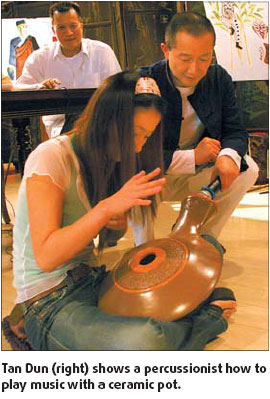
In Act I, the well-dressed women percussionists pour the water into big glass bowls. In Act II, paper is rustled, rippled, crumpled and torn to create the sound of wind. In Act III, the monks tap stones together rhythmically to increase dramatic intensity preceding the princess' murder by her brother.
Tan has the stones emitting a feeling of fate, paper a smooth sensuality and water an ominous message of birth and rebirth.
Tan had played around with similar ideas in his earlier works: Soundshape (1989), Ghost Opera (1994), Water Concerto (1998) and Water Passion After St.Matthew (2000).
"For many years I have continued to experiment with the use of water, paper and ceramic as instruments in my music," says Tan. "As I was traveling around China and Japan to research tea, I came to the realization that 'organic music' already existed in these two countries.
"As is suggested in this example, 'organic music' concerns both matters of everyday life and matters of the heart, and I have attempted to underpin Tea with this concept.
"In the Book of Tea itself, the author Lu Yu writes about water, wind, fire and earthenware, and I wanted to assimilate all of these elements into my work, because they are all essential to the aesthetics of tea."


