By Zhao Yi
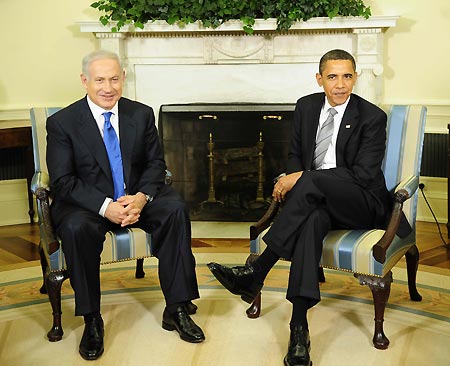
The summit meeting between US President Barack Obama and Israeli Prime Minister Benjamin Netanyahu at the White House on Monday has reasserted their long-term commitment to being close allies in regional and international affairs.
 |
|
US President Barack Obama (R) meets with visiting Israeli Prime Minister Benjamin Netanyahu at the Oval Office of the White House in Washington, capital of the United States, May 18, 2009. [Zhang Yan/Xinhua] |
However, the two new leaders seemed to have second thoughts on the solution of the Israel-Palestinian conflict, as well as the Iran issue.
Two-state solution?
At their talks, Obama was apparently trying to seek support from the hawkish Israeli leader over the "two-state solution", which has been advocated by Obama's predecessor George W. Bush.
"It is, I believe, in the interests not only of the Palestinians but also the Israelis and the United States and the international community to achieve a two-state solution in which Israelis and Palestinians are living side by side in peace and security," Obama told a joint press conference after the talks.
"I suggested to the prime minister that he has a historic opportunity to get a serious movement on this issue during his tenure... And I think that we can -- there is no reason why we should not seize this opportunity... And I am confident that in the days, weeks and months to come that we are going to be able to make progress on that issue," he said.
However, Netanyahu, who was sitting beside Obama, shied away from talking about the future of a Palestinian state that Washington and the Palestinians have been pursuing. He did not even mention a "Palestinian state".
Instead, for his part, Netanyahu reiterated Israel's persistent demand that the Palestinians recognize the existence of Israel. "If we resume negotiations, as we plan to do, then I think that the Palestinians will have to recognize Israel as a Jewish state and will have to also enable Israel to have the means to defend itself," he said.
This shows the two leaders remain quite far apart over the solution of Israeli-Palestinian problems. Tough negotiations lie ahead and some painful compromises are inevitable before the US, Israel and Palestine could finally clinch an agreement.
Iran's nuclear threat?
Netanyahu's cool response to the two-state solution came as no surprise. And in contrast, the prime minister voiced grave concern over Iran's nuclear issue while hold talks with Obama.
"The worst danger we face is that Iran would develop nuclear military capabilities. Iran openly calls for our destruction, which is unacceptable," said Netanyahu, "It threatens the moderate Arab regimes in the Middle East. It threatens US interests worldwide."
"If Iran were to acquire nuclear weapons, it could give a nuclear umbrella to terrorists, or worse, could actually give (them) nuclear weapons. And that would put us all in great peril," he said.
In a tactful response to Israel's concerns, Obama said:" If there is a linkage between Iran and the Israeli-Palestinian peace process, I personally believe it actually runs the other way."
"To the extent that we can make peace between the Palestinians and the Israelis, then I actually think it strengthens our hand in the international community in dealing with the potential Iranian threat," he added.
While both countries regard a nuclear Iran as the biggest threat in the Middle East, their strategies to deal with it differ. The Obama administration favors a diplomatic resolution of its disputes with Iran, while the hawkish Netanyahu has repeatedly said that Israel would not sit idly by in the face of Iran's nuclear program.
Remaining close allies
For all their differences, the traditional alliance between the US and Israel shows no signs of beginning to break up. During his visit, Netanyahu reiterated Israel's commitment to stand by the US and said he had great confidence in Obama's efforts to maintain peace and security in the Middle East.
In fact, the US government has greatly increased its military aid to Israel. Under a deal signed in August 2007, Washington's military aid to Israel is to increase from 24 billion US dollars to 30 billion US dollars over the next 10 years.
Whatever happens, in Israel's dealing with Arabs and Islamic countries, and particularly in handling disputes with Iran, Washington still holds considerable sway.
(Xinhua News Agency May 20, 2009)
