Visiting US Middle East envoy George Mitchell on Thursday repeatedly urged his hosts to adopt the two-state principle concerning the Israeli-Palestinian peace process, yet eventually proved that the guideline needs a hard sell to the new Israeli government.
After meeting with Israeli Foreign Minister Avigdor Lieberman around noon, Mitchell told reporters that "I reiterated to the foreign minister that US policy favors, with respect to the Israeli-Palestinian conflict, a two-state solution which will have a Palestinian state living in peace alongside the Jewish state of Israel."
 |
|
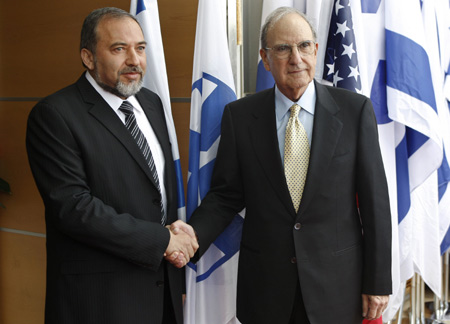
Israel's Foreign Minister Avigdor Lieberman (L) shakes hands with US envoy George Mitchell before their meeting in Jerusalem April 16, 2009. [Xinhua] |
Earlier in the day, the US emissary also stressed to Israeli President Shimon Peres that his country, which is Israel's main ally, is committed to Israel's security as well as a two-state solution to the decades-old conflict between the two Mideast neighbors.
The former US senator also met with new Israeli Prime Minister Benjamin Netanyahu on Thursday evening. While details of their meeting were not released, Mitchell was expected to ask Netanyahu to clarify his administration's stance on the peace process and reiterate the US commitment to the two-state principle.??
His unflagging advocacy reflected the overture recently made by new US President Barack Obama, who said earlier this month that his administration is determined to help reach a two-state solution to the Israeli-Palestinian conflict.
However, responses from his hosts conveyed obvious reluctance to endorse the principle, which Mitchell said before his arrival on Wednesday night was the best and only way to solve the unwieldy issue, yet which has not crossed Netanyahu's tongue.
Officials in Netanyahu's office were quoted by local new service Ynet as saying that the premier told his guest that Israel has no desire to rule over the Palestinians, but has to maintain its own security, as the creation of a Palestinian state at the current stage could give a rise to another Hamas-controlled entity threatening Israel from the West Bank.
Netanyahu also reportedly conditioned the start of talks on a two-state solution on a recognition by the Palestinian side of Israel as a Jewish state, a demand the Hamas-led Palestinians have rejected amid worries that such a move would virtually deprive the Palestinian refugees of their right of return.
The traditionally hawkish premier recently made repeated pledges to advance the peace process, but has so far stopped short of underwriting the two-state principle.
He has been arguing that efforts should be concentrated first on developing the Palestinian economy, yet the so-called "economic peace" plan not only incurred outright rejection from the Palestinian side, but ran into a cold shoulder from the United States.
Neither did the two-state principle get any lip service from Lieberman during his appearance with Mitchell before the press.
The new top Israeli diplomat, according to a statement from his office, said that "the traditional approach has so far brought neither results nor solutions" and that "the Israeli government will have to formulate new ideas and a new approach."
On his first day in office, the foreign minister said that concessions only invite more wars, and that the only document binding on Israel is the 2003 "road map" peace plan, which implies that the two sides must fulfill certain obligations before they could negotiate core issues.
The stance thus far manifested by the new Israeli government, which is dominated by hardline right-wing parties, together with the stalemated reconciliation process between Fatah and Hamas within the Palestinian side, augurs an elusive prospect for the Palestinian statehood in the near future.
In a bid to push forward the peace process, the US envoy reportedly planned to set up an office in Jerusalem and visit the region as often as in every three weeks.
During the latest visit, his third since he took the post in January and first since the Netanyahu administration was sworn in late March, Mitchell is scheduled to meet on Friday with Palestinian officials in the West Bank.
(Xinhua News Agency April 17, 2009)
