By Zhou Jun, Lian Haidong & Fei Liena
The terrorist attacks in India's financial capital Mumbai starting Wednesday night have shocked the world with their brazenness and brutality. The attacks have added to a mounting sense of insecurity in the city and people are still struggling to come to terms with the fallout from the three-day rampage.
 |
|
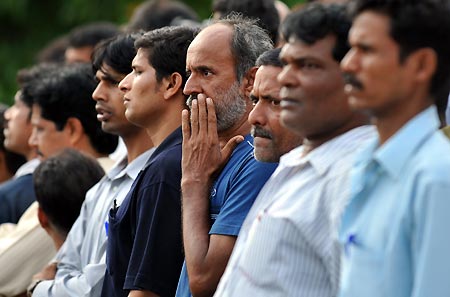
Indian people look at Taj Mahal Hotel where terrorist attack took place in Mumbai, India, November 30, 2008. After the final siege at the Taj Mahal hotel, lives of people in Mumbai began to return to normal. But the main areas, which were attacked by the terrorists, are still blocked by the police. [Liu Sui Wai/Xinhua]
|
Terrorist attacks more frequent
India has witnessed deadly terrorist attacks almost every year in recent years, with casualties running into thousands. Since a wave of bombings hit Jaipur in May, several large Indian cities, including New Delhi and Bangalore, all became targets of terrorist attacks, which resulted in heavy casualties and losses.
As India's financial capital and the most populous city, Mumbai has come under terrorist attacks three times in recent years, the previous two being in 1993 and 2006. The latest attacks were more serious in terms of their magnitude.
The attacks were well-planned and the gunmen were cold-blooded. They were well-equipped and trained. They hurled grenades, fired indiscriminately, took people hostage and attacked hotels and hospitals.
Experts point to the level of sophistication of the attacks and also note that foreigners were targeted for the first time in terrorist attacks in India.
 |
|
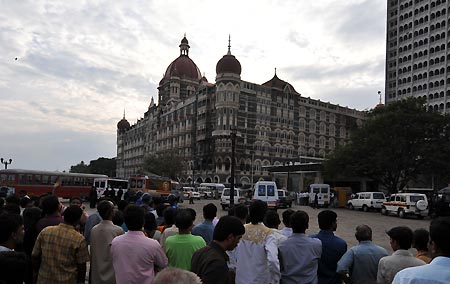
Indian people look at Taj Mahal Hotel where terrorist attack took place in Mumbai, India, November 30, 2008. After the final siege at the Taj Mahal hotel, lives of people in Mumbai began to return to normal. But the main areas, which were attacked by the terrorists, are still blocked by the police.[Liu Sui Wai/Xinhua]
|
Causes behind the terror attacks
Against a backdrop of intensified anti-terror efforts globally, there are deep-rooted causes behind the rampant terrorist activities in India.
Firstly, sectarian conflicts are serious in India. With many sects in the country, mostly belonging to Hindus and Muslims, many conflicts erupt between the two communities, fighting for different religious beliefs and their own interests.
A previously unknown group calling itself Deccan Mujahedeen claimed responsibility for the attacks, fueling speculation they might be linked to the Indian Mujahedeen formed by Islamic extremists, which had sent emails claiming responsibility for four attacks it said it mounted between November 2007 and September 2008.