|
|
|
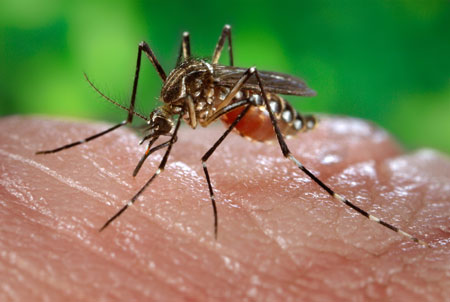
This 2006 photograph depicts a female Aedes aegypti mosquito while she was in the process of acquiring a blood meal from her human host. [Xinhua/Reuters] |
In a daring experiment in Europe, scientists used mosquitoes as flying needles to deliver a "vaccine" of live malaria parasites via their bites.
The results were astounding: Everyone in the vaccine group acquired immunity to malaria; everyone in a non-vaccinated group did not, and developed malaria when exposed to the parasites later.
The study was only a small proof-of-principle test, and its approach is not practical on a large scale. However, it shows that scientists may finally be on the right track to developing an effective vaccine against one of mankind's top killers. A vaccine that uses modified live parasites just entered human testing.
"Malaria vaccines are moving from the laboratory into the real world," Dr Carlos Campbell wrote in an editorial accompanying the study in yesterday's New England Journal of Medicine. He works for PATH, the Program for Appropriate Technology in Health, a Seattle-based global health foundation.
Malaria kills nearly a million people each year, mostly children under five and especially in Africa. Infected mosquitoes inject immature malaria parasites into the skin when they bite; these travel to the liver where they mature and multiply. They then enter the bloodstream and attack red blood cells - the phase that makes people sick.
People can develop immunity to malaria if exposed to it many times. The drug chloroquine can kill parasites in the final bloodstream phase, when they are most dangerous.
Scientists tried to take advantage of these two factors, by using chloroquine to protect people while gradually exposing them to malaria parasites and letting immunity develop.
They assigned 10 volunteers to a "vaccine" group and five others to a comparison group. All were given chloroquine for three months, and exposed once a month to about a dozen mosquitoes - malaria-infected ones in the vaccine group and non-infected mosquitoes in the comparison group.
That was to allow the "vaccine" effect to develop. Next came a test to see if it works.
All 15 stopped taking chloroquine. Two months later, all were bitten by malaria-infected mosquitoes. None of the 10 in the vaccine group developed parasites in their bloodstreams; all five in the comparison group did.
The study was done in a lab at Radboud University in Nijmegen, the Netherlands.
(Shanghai Daily July 31, 2009)