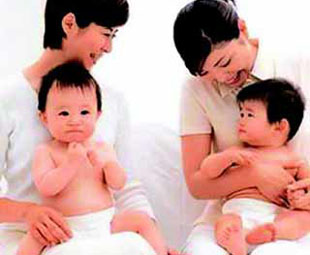
Babies might seem a bit dim in their first six months of life,
but researchers are getting smarter about what babies know, and the
results are surprising.
The word "infant" comes from the Latin, meaning "unable to speak,"
but babies are building the foundations for babbling and language
before they are born, responding to muffled sounds that travel
through amniotic fluid.
Soon after birth, infants are keen and sophisticated observers,
capable of seeing details in the world that are visible to some
other animals but invisible to adults, older children and even
slightly older infants.
Recently, scientists have learned the following:
At a few days old, infants can pick out their native tongue from
a foreign one.
At 4 or 5 months, infants can lip read, matching faces on silent
videos to "ee" and "ah" sounds.
Infants can recognize the consonants and vowels of all languages
on Earth, and they can hear the difference between foreign language
sounds that elude most adults.
Infants in their first six months can tell the difference
between two monkey faces that an older person would say are
identical, and they can match calls that monkeys make with pictures
of their faces.
Infants are rhythm experts, capable of differentiating between
the beats of their culture and another.
The findings, presented in the latest issue of the journal
Science, is that infants just 4 months old can tell
whether someone is speaking in their native tongue or not without
any sound, just by watching a silent movie of their speech. This
ability disappears by the age of 8 months, however, unless the
child grows up in a bilingual environment and therefore needs to
use the skill.
In fact, all the skills outlined above decline somewhere around
the time infants pass the 6-month mark and learn to ignore
information that bears little on their immediate environment.
The new study involved showing videos to 36 infants of three
bilingual speakers reciting sentences.
After being trained to become comfortable with a speaker
reciting a sentence in one language, babies ages 4 and 6 months
spent more time looking at a speaker reciting a sentence in a
different language - demonstrating that they could tell the
difference.
(China Daily via agencies May 28, 2007)