Elion Group makes the desert bloom
- By Sarah Bellemare
 0 Comment(s)
 Print
Print E-mail China.org.cn, September 23, 2014


|
|
|
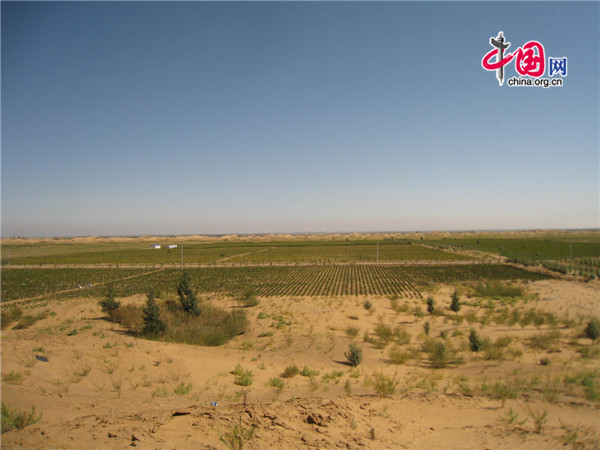
Some of the agricultural land reclaimed from the Kubuqi desert by Elion Resource Group's afforestation projects. The fields pictured here are currently being used for a new tree-farming project. One can still see miles and miles of as-yet unreclaimed sand dunes in the distance. [Photo by Sarah Bellemare/China.org.cn] |
The company has also maintained a focus on improving the welfare and livelihoods of local residents. In an interview with China.org.cn, Wang emphasized the fact that, "Many people don't understand that the desert is a place where people live, so finding a way to make people's livelihoods sustainable is one of the more important problems that we have to solve." According to data issued by Elion, the average annual income of a household in Kubuqi has risen from around 1800 RMB in the mid-1990s to over 30,000 RMB today. Elion continues to rent most of the land devoted to its various projects from locals, and it employs locals to manage and maintain its farms. Gao, who manages nearly 100 local laborers, says that, "Even though we are employees of Elion and we ultimately work for them, we are very grateful to the company because it has raised our standard of living significantly and has shared its prosperity with the local people."
However, much of Elion's oasis restoration work has necessitated the dislocation of many of the area's herdsmen. Like most locals in Elion's restoration area, Gao and He no longer keep any herding animals, and they live in a European-style townhouse in a village with a modern layout built by Elion less than a decade ago. Although one of Elion's many ventures includes a tourism center that aims to preserve some of the Kubuqi area's Mongolian desert culture, all those involved admit that some amount of cultural heritage has been lost.
Elion is also concerned about the sustainability of their investment structure, which has relied fairly heavily on government support for many of their projects. Over the past few years, they have hosted a series of conferences in Kubuqi which aim to help Elion establish partnerships with other enterprises throughout China and the world. In 2013, the company also established the Global Consortium for Eco-civilization Scientists Union, an organization of researchers, public servants, and business leaders that promotes stronger and more efficient links between environmental research and the institutions that can put that research into practice.
Wang says that he hopes Elion can present their work in Kubuqi as "a platform for expanding our approach to ecological development to other regions. Many of our specific methods, such as the kind of plants used, have to be changed and re-developed for different places, but the basic model is the same." Elion has also been in contact with organizations in Africa and Australia in the past few years and hopes to establish close working relationships with countries in those nations so that they can bring the successes of Kubuqi to other parts of the world.


