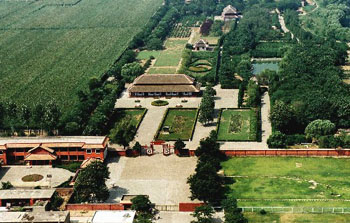
Lying about 2 km northwest of Anyang City, the Yin Ruins cover an area of 30 square km. It was once the capital of the Shang Dynasty empire 3,300 years ago and is the first capital ruins with a historical record confirmed by oracles and archaeological excavations. "Yin" was the ancient name for the Shang Dynasty (1600 BC-1100 BC).
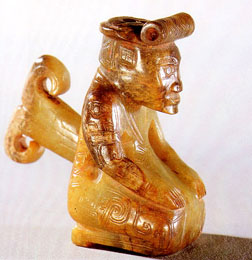
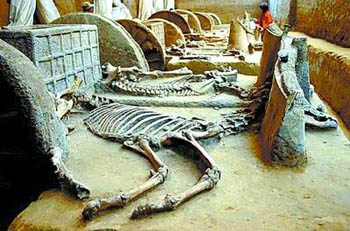
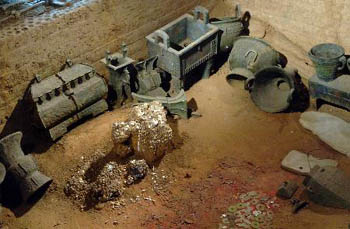
The ruins have been dubbed the "cradle of Chinese archaeology" by archaeologists. Excavations which started in late 1920s have revealed tombs, foundations of palaces and temples, bronzes, jade carvings, lacquer ware, white carved ceramics, green-glazed ware and oracle bones.
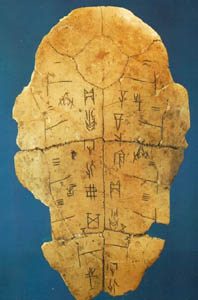
One of the most significant discoveries are inscribed animal bones and tortoise shells, known as the oracle bones, which carry the earliest known examples of Chinese characters. Since its excavation in late 19th century, more than 150,000 pieces of animal bones and tortoise shells bearing inscriptions recording harvests, astronomical phenomena, worship rituals and wars have been unearthed here, providing scholars with valuable historic and linguistic information.
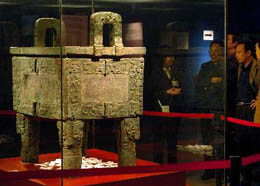
The ruins also bear witness to the prime of China's bronze age. The four-legged bronze cauldron Simuwu Ding, discovered in 1939, measures 133 cm in height and weighs 875 kg. It is the world's biggest bronze ware item ever excavated. Archaeologists said it was used in worship ceremonies and was also a symbol of the aristocrats at that time.
The asymmetric city layout, which has been adopted by many Chinese cities including Beijing for over 3,000 years, also originated from these ruins. The capital included palaces, a burial ground, a civil residential quarter, a bronze-casting workshop and places of worship.
Besides, the tomb of China's first female general, Fuhao, wife of one emperor of the Shang Dynasty, was also discovered in the ruins.
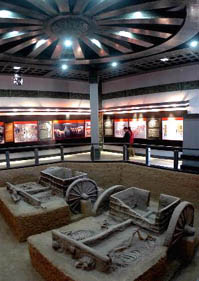
A museum was completed and opened to the public in September 2005 for the precious items unearthed from the ruins. The tomb of Fuhao, together with 36 pits for worship, had been restored to their original look. Over 560 characters inscribed on shells and bones were on display with annotations in modern Chinese and English.
Because of its outstanding universal value, the Yin Ruins was enlisted as a World Cultural Heritage site of UNESCO on July 13 at the 30th Session of the World Heritage Committee (WHC) in Lithuania.
Yin Ruins Museum of Anyang, Henan Province
Tel: 86-372-393 2171; 393 7159
Post code: 455000
Website: http://www.ayyx.com/en/index.htm
(China.org.cn August 1, 2006)