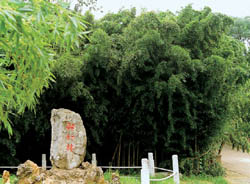
 The Hongluo Temple (Tradition has it that two spiral shells gave out red light in the evening) is located at the foot of the Hongluo Mount 7 kilometres northwest of Huairou County. It was first built in the Tang Dynasty (618 - 907). Its origninal name was Daming (Great Brightness) Temple, and was then changed to Zifu (Fortune Supple) Temple in the Ming Dynasty (1368 - 1644).
Covering an area of 16.6 acres, the Hongluo Temple is the biggest temple in the northern area of Beijing. The temple is divided into 5 courtyards. The central courtyard, taking Shanmen (the entrance of the temple), Tianwangdian (Hall of Heavenly Kings), Daxiongbaodian (Hall of Mahavira), and the Meditation Room as axes together make up 3 halls namely, the Hall of Teaching Buddhist Scripture and two accompanying halls in the east and west sides. The eastern courtyard consists of a guestroom and diing rooms. The western courtyard comprises of Abbot's Cell and Shifangtang. The eastern back yard consists of Yanshoutang (the room for prolonging life), with the Monk's Hut in the north and an arena for practising Qigong in the south, In the far west is the tower yard which consists of the Ash Room for monks, the monk pagoda and the Pagoda of the spiral Shell.
The temple was the Holy land of Buddhism at that time. Here was also the birthplace of Jinghua Qigong. Many senior Buddhist monks were trained and practised here. There is an account of thirteen founders in the book entitled Nian Song Yi Gui. Their twelfth founder was Hongluo Zituxingongdashi, or Great Master of Zifuxinggong. The temple was a resident temple in which Buddhist monks were engaged in advanced studies, and abbots were cultivated for other temples. The thirtieth founder of Yinguangdashi, the Great Master of Yinguang had also taught here. Therefore the senior Buddhist monks from Japan and Southeastern countries often went on a pilgrimage and studied Buddhist scripture here. The temple was deeply honoured by the emperors of the past ages. The temple was rebuilt many times. Emperors even came here to burn incense and prostrate themselves before the statue of the Buddha. The temple was therefore quite well known both at hime and abroad.
Surrounded by hills dotted with pines and cypresses in thousands of different and graceful shapes, the temple is a place of quiet contemplation and is tastefully laid out. There is a Zhen Zhu Quan (the Spring of Pearl) in the west where the spring water is green and transparent and the rising bubbles are said to be like pearl. In the south, the visitor can go boating, swimming and fishing in the Hongluo Reservoir. There are towering old trees in the yard and among them Chinese wisteria adopted by pine trees. Male and female ginkgoes and green bamboo are said to be the "Three Matchless Sceneries" in Beijing.
The Hongluo Temple has been listed as one of the important cultural relics to come under Beijing Municipality protection. It has now a sacred place to sightseers after several years of successful renovation.
Transportation: Tourist bus as 6 or 16 at Xuanwumen, Dongdaqiao Bridge, Hepingmen and Dongsishitiao, or 916 bus at Dongzhimen bus stop. Tour buses to Huairong are available at Qianmen during rush season.
Address: Four kilometers from Qingchun road in the north HuaiRou Beijing .
Tel: 010-69620967 69647639
Ticket: 20 yuan (US$2.5)
(China.org.cn)
|