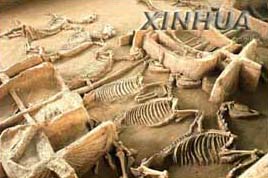
 After rounds of hearings, Luoyang City leaders in central China's Henan province have finally decided on the design for a cultural square.
Together with dozens of display rooms, a special museum highlighting a renowned horse-and-chariot pit will also be built.
Believed to date to the Eastern Zhou Dynasty (770 B.C.- 256 B.C.), the pit contains six clay horses and one chariot, a form echoing ancient records that the earliest Chinese emperors rode in chariots pulled by six fine horses.
With the exception of the chariot pit exhibit, most of the display cells or windows will be built below the surface of the 16,000-square-meter square, which aims to mirror the splendid historical culture of Luoyang during the Eastern Zhou period.
Construction of the square began late last year, and site workers have since found 397 Eastern Zhou period tombs and 18 horse-and-chariot pits. The pit is considered as the most valuable of its kind since it provides sound proof of ancient emperors' lifestyles.
Large in scale and intact, the pit is reputed to be unique, and a major clue into China's history from the 21st century B.C. to year 221 B.C.
Amid the trees and grassy patches dotted around the square, a 1,200-square-meter museum sits, consisting mainly of a four-square horse-and-chariot museum and other quadrangular Eastern Zhou Dynasty cultural relic display rooms, half buried in the earth, with the upper half in platform shape.
All the other affiliated rooms, also housing cultural relics, will be built underground. The body of the horse-and-chariot museum is expected to complete by late June.
(People's Daily June 13, 2003)
|