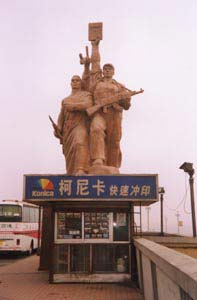
 "Revolutionary" isn't usually the word which pops into one's mind at the thought of bridges--at least not revolutionary in the political sense. But the Nanjing Yangzi River Bridge is just that: A bridge of revolutionary proportions both technologically and politically. Construction started under the guidance of engineers from the Soviet Union, but the Soviets pulled out in 1960 when a political rift developed between China and the USSR. Although legend has it that the Soviets took all the plans with them, the Chinese Communists plunged ahead on their own and finished the bridge in 1968.
With a span of 1.5 kilometers, the double-decker bridge is a mighty and apt symbol of the power of the revolutionary masses. Chairman Mao's slogan splashed in huge red characters on one of the eastern buttresses emphasizes this point: "The people - only the people - are the driving force behind world history." Relief carvings along the span depict the triumph of the proletariat while oversized statues of peasants, workers and soldiers dwarf the traffic thundering by.
Apart from the bridge's political significance, it allowed the completion of the first direct rail link between Beijing and Shanghai. Before, the train had to be ferried across the river, which took over two hours. Today, the crossing takes about two minutes along the lower deck.
Access to the bridge is through the Great Bridge Park, located under and around the span on the southern bank of the Yangzi River (the same side as the city of Nanjing). An elevator to the bridge's upper deck plus a small museum are located in the massive columns. Once on the roadway level, you can climb to an observation platform for another view of the Yangzi, the bridge, and the city of Nanjing.
If you chose to take a bus to the bridge, lines 15, 67 and 69 terminate just across the street from the park's entrance.
Opening Hours: Daily 6:30 ? 20:00.
Admission Price: 7 yuan for the grounds and additional 2 yuan to go up in the elevator.
Tel: 025 -8795566
(china.org.cn February 26, 2003)
|