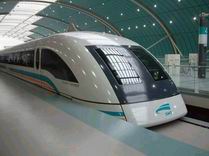
Plans for a magnetic levitation railway between Beijing and Shanghai were shelved yesterday, Beijing Times said in a report Thursday.
Sources attending a January 7 meeting of the State Council said the new high speed railway link will be built using the less expensive wheel-track method, the report said. The meeting was chaired by Premier Wen Jiabao and passed in principle a mid and long-term railway network plan.
However, sources with the long-term planning office of the Ministry of Railways said yesterday discussions on which technique to use are ongoing.
"We have not got any information (that the wheel-track technique will be adopted) from our superior department," the sources said, refusing to comment further.
Beijing Morning Post Friday cited an official with the publicity department of the Railway Ministry as saying that the plan does not mention the technique the Beijing-Shanghai railway will finally use.
Several experts with the Chinese Academy of Railway Sciences, also refused to comment on the issue.
The Beijing-Shanghai High-Speed Railway Project was first proposed in 1997 and was later listed in China's 10th Five-Year Plan (2001-05). The 1,300-kilometre railway line is expected to cost 120 billion yuan (US$14 billion).
It is expected to shorten traveling time between the nation's capital and its financial hub from 13 hours to less than five.
There are several options for construction of the railway. Among the techniques under consideration are Japan's Shinkansen, France's TGV and Inter-City-Express (ICE) and the magnetic levitation (maglev) from Germany.
Shinkansen, TGV and ICE would all be wheel-track based.
There have been heated debates among Chinese experts on whether the wheel-track or the maglev technique should be adopted.
Ultimately, however, the maglev technique was excluded because it does not match the wheel-track technique used by railways in China, Wang Derong, vice-chairman of the China transport association, was quoted as saying.
Given that the Beijing-Shanghai line links up more than 20 other railway lines, it has to be compatible with other trains, Wang said.
What's more, the cost of the maglev technique is as high as 300 to 400 million (US$36 to 48 million) per kilometer, twice that of wheel-track lines, he said.
Wang said the next step will be to decide which technique to adopt and how to raise funds.
The techniques from Japan, France and Germany all have their advantages, Wang said.
Price and compatibility will be two factors that decide which country's technique will be adopted, he said.
The present railway linking Beijing and Shanghai is one of the busiest passenger and cargo transport routes in China.
The volume of passenger and cargo transport on the line is 5.5 times and 4.3 times the national average respectively.
The line can be maintained for another 10 to 20 years, but it would then meet only 50 percent of the demand.
(China Daily January 16, 2004)