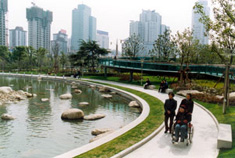
Researchers at East China University of Science and Technology (ECUST) have discovered a way to use micro-organisms to clean up polluted waterways, such as man-made ponds and creeks in residential areas, which have become a major source of complaints in the city.
The system, which was invented at ECUST's school of environmental resources, employs natural plants that can activate micro-organisms in the soil or water and form a reagent to be sprayed on the water surface.
"We have proved that the biochemical activity of micro-organisms can get rid of surplus algae in the water. Therefore, promoting the function of native micro-organisms could help to clean water naturally," explained Lu Zhu, an ECUST professor and director of the research program.
The technology will allow researchers to design tailor-made reagents for each polluted waterway in the city, depending on its own biological make-up, Lu said.
Many developers have built man-made lakes and creeks in residential complexes in the city over the past few years to attract more buyers and boost property prices.
Many of the waterways are stagnant, however, and easily become polluted after extensive exposure to the air and sun.
"I was very excited to see a river under my window when I moved into my new apartment. But the water began to turn green after six months and became black and gave off an unbearable smell after one or two years," said Yuan Chunfen, who lives in a residential area on Putuo District's Wuning Road.
She said the dirty water has become a breeding ground for mosquitoes and other insects.
A survey of 65 residential areas in the city indicated that only about 36 percent of man-made waterways met national quality standards for landscaping water.
Property developers say that it often costs too much money to keep the lakes and creeks clean.
"We could be willing to recommend the new method to property owners if it is not that expensive," said Gao Mingyuan, deputy general manager of Shanghai Shunda Property Management Company.
Lu wouldn't say, however, exactly how expensive the new water treatment system will be.
(Shanghai Daily February 15, 2006)