On December 18, Chinese scientists for the first time successfully obtained samples of hydrothermal sulfide and life forms living near a deepwater hydrothermal vent during an expedition in the Indian Ocean.
They detected unusual salinity and turbidity at longitude 70°24' east and latitude 25°19' south, and used undersea cameras to observe many organisms including sea anemone and shrimps living along the 2,400 meters mid-ocean ridges there.
This indicated the existence of a nearby hydrothermal vent, or "black smoker." The scientists then obtained the 45-kilogram sample of hydrothermal sulfide using remote controlled equipment.
According to Guo Shiqin, chief scientist of the Ocean No.1 mission, this is the first time for them to see such good piece of hydrothermal sulfide.
One of the minerals produced through deep sea hydrothermal activity, the hydrothermal sulfide contains many non-ferrous metals including bronze and zinc and may one day provide a substitute for land mineral resources.
Research into life forms living in deep sea hydrothermal environments could also be of great scientific and economic value, due to their ability to resist extreme pressures, temperatures and viruses.
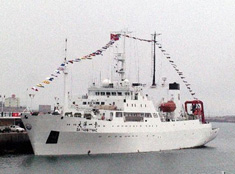
Ocean No.1 is China's top marine research ship, weighing 5,600 tons and equipped with state-of-the-art equipment.
It departed from Cape Town in South Africa at 2 PM on November 23 for China's first scientific expedition in the Indian Ocean, scheduled to last more than 40 days and travel over 6,000 sea miles.
As well as obtaining samples of hydrothermal sulfide and life forms, the expedition aims to conduct geological, geophysical and geochemical research into the Indian Ocean mid-ocean ridge and look for new hydrothermal regions.
Ocean No.1 will also travel near Indonesia's Sumatra Island where the severe earthquake-triggered tsunami took place last year and collect data on the area's terrain, active fault structure, sediment and volcano.
(China.org.cn by Wang Qian, December 21, 2005)