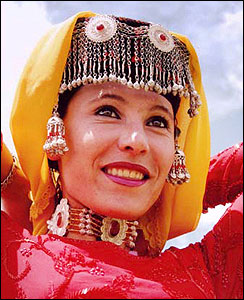
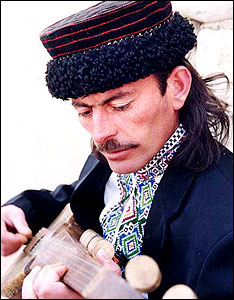
Living Areas: The majority of Tajik people inhabit the Taxkorgan Tajik Autonomous County in the northwest extreme of Chinese territory. These are "Selekur (highland) Tajiks." They have fair skin, blonde or brown hair and blue or grey eyes, and have lived in central Asia since antiquity.
Population: The 2003 census counted 40,900 Tajiks in Xinjiang, 0.21 percent of the region's population.
Language: The Tajiks have an oral language with no written form. The Tajik tongue belongs to the Iranian group of the Indo-European family of languages. Most Tajiks in Taxkorgan speak the Selekur dialect, others the Wahan dialect. Around 60 percent also speak the Uygur language.
History: The word "Tajik" means "crown" in their language. The traditional explanation is that they live on the "crown" – the highest mountain ranges. According to Tajik custom, they are descended from eagles. Beautiful legends of the "princess' castle," "eagle dance," "eagle flute" and dap (drum) are still passed on today.
The present Taxkorgan area has had numerous names. In 1913, it became a county under the jurisdiction of Kashi Prefecture. The local people's government was founded in 1950. On September 17, 1954, the current autonomous government replaced it.
Economy: Farming and animal husbandry are the two key sources of income for Tajiks. They also go hunting and engage in other subsidiary production. Horticulture, for example, is common among those in Datong township.
Diet: The Tajiks have beef, mutton, dairy products and pita bread as traditional staple foods.
Culture: Tajik musical instruments include a three-holed "eagle flute," rawap, brazkom and dap. The eagle dance is a favorite.
Holidays: The Tajiks celebrate Corban, Shogonbahar, as well as Water Drawing, Sewing and Lantern festivals.
Religion: The Tajiks' ancestors were Zoroastrians, but in the late 11th century they started to convert to Islam, which remains the dominant religion.
Costume: Typically, Tajik men wear gowns called qiapan, tied up with a long cloth band around waist. Qiapans are matched by embroidered skull caps. Women like brightly-colored dresses and embroidered kuleta caps.
Marriage: The Tajiks practice monogamy. Their wedding ceremonies last for three days, where people sing and dance to music played with eagle flutes and daps. The new weds' married life is considered to start on the third day, when the senior host lifts the bride's veil.
Residence: Tajik homes, langelis, are wood-stone or wood-adobe structured bungalows. Without any windows, such buildings have wood built skylights instead. A typical langeli has five supporting pillars inside.
(china.org.cn August 25, 2005)