Living Areas: The Xibes of Xinjiang mostly inhabit Charbur Xibe Autonomous County in Ili. Others live in the counties of Huocheng and Guliu, in addition to Urumqi City.
Population: The Xibe population in Xinjiang was numbered 40,300 in the 2003 census, 0.21 percent of the regional total.
Language: The Xibe language belongs to the Manchu-Tungusic branch of the Altaic language family. Its written form is based on Manchu script.
History: The main body of the ethnic group in Xinjiang who call themselves the "Xibes" came to the northwest frontier in 1764. The Qianlong Emperor of the Qing Dynasty sent 1,018 Xibe troops to Ili to garrison the border, reclaim wasteland and grow food crops. They were transferred from 17 cities under the jurisdiction of Shengjing (current Shenyang) in northeastern China, including Shenyang, Kaiyuan, Yizhou, Sucheng, Xiongyue, Fuzhou, Jinzhou, Xingjing, Haicheng and Fushun.
Trekking with the troops were their families, totaling over 2,000 people. The whole force left Shengjing on the 18th day of the 4th lunar month and it took them one year and five months to arrive in Ili. Present-day Charbur was where their guard station was set up. In 1767, the community was put into eight subdivisions (called "banners") under the Xibe garrison camp. While performing military duties, they cultivated virgin land and built irrigation systems.
Economy: The Xibes today still largely live on food farming. They also engage in raising livestock, fishing and hunting.
Diet: Wheat flour is the Xibes' traditional staple food. Daily meals consist of rice and corn flour.
Culture: The Xibes are proficient horse riders and marksmen, and Charbur is known as the "hometown of marksmanship." Traditional musical instruments include the donbur and mokna.
Holidays: The Xibes celebrate Spring Festival and West-Moving Festival (the 18th day of the 4th lunar month).
Religion: Historically, the Xibes believe in Shamanism or Lamaism.
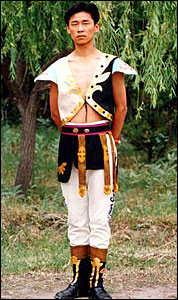
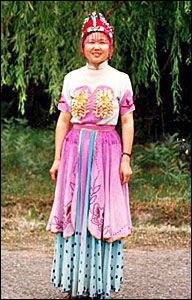
Costume: Much influenced by age-old Manchu ways, Xibe men traditionally wear long gowns with open seams to the knees on both sides. Women wear qipao, close-fitting long gowns, and embroidered shoes. They often wear earrings, bracelets and rings.
Marriage: Monogamy is usual among the Xibes. Getting married would involve several steps: proposal by the groom's family, the bride's family agreeing, engagement and the wedding itself. Before a wedding, a trusted couple would talk to both families and make arrangements for the ceremony.
Residence: Conventional Xibe homes are ridge-roofed wooden and adobe structures.
(China.org.cn August 25, 2005)