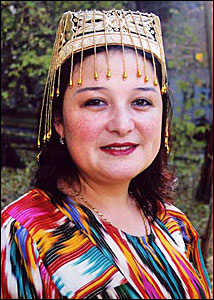
Living Areas: Most Ozbek people in Xinjiang live in Kashi, Yining, Tacheng, Urumqi, Shache and Yecheng.
Population: The Ozbek population of Xinjiang was 14,600, 0.08 percent of the region’s total, in the 2003 census.
Language: They speak the Ozbek language of the Turkic language group of the Altaic language family, but the Uygur language is also widely spoken among them.
History: The Ozbek people were recorded in China’s History of the Yuan Dynasty. They were ruled by the Mongolian Golden Camp Khanate in the 14th century. As the khanate dissolved in the early 15th century, a branch of it rose and founded the Ozbek Khanate. An Ozbek nation thus took its shape that century. Some Ozbek merchants and their families from Central Asia settled in Xinjiang during the 16th and 17th centuries, when they were known as Anjiyan, Buhara and Haohan people.
Economy: Most of the Ozbeks are merchants or craftspeople. A small number in northern Xinjiang are herdspeople and some in the south are farmers.
Diet: Wheaten foods constitute the major part of the traditional Ozbek menu. They include crispy pita bread, noodle soup, hand-pulled noodles and stuffed buns. Naren, mince cooked with onion and sour milk and dressed with gravy and pepper, is a table delicacy reserved for guests. Zhuafan, rice cooked with mutton and carrots and eaten using the fingers, is another famous Ozbek specialty.
Culture: Oral traditions have a long history among the Ozbeks, including myths, folklore and fables, as well as epics, narrative poems and folk songs.
Holidays: The Ozbeks celebrate Corban and Rosun as their major holidays.
Religion: The Ozbek people used to be believers of Zoroastrianism and Lamaism, but Islam became the prevalent faith in the 14th century when the Ozbek Khan ruled.
Costume: Ozbek men traditionally wear embroidered skull caps and shirts with cross-stitched patterns; women wear scarves or kerchiefs and colorful dresses.
Marriage: The Ozbeks practice monogamy. Marrying non-Muslims is forbidden. According to tradition, a younger sister does not get married until her older brother has. Similarly, a younger brother only gets married after his older sister’s marriage.
Residences: Ozbek homes tend to be wooden-framed adobe bungalows with characteristic porches.
(China.org.cn August 25, 2005)