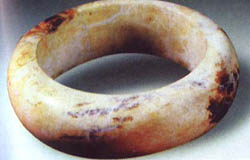
Ancient Chinese craftsmen might have learned to use diamonds to grind and polish ceremonial stone burial axes as long as 6,000 years ago, according to a report published in the February issue of the journal Archaeometry.
A team of researchers led by Peter J. Lu, a graduate student in physics at Harvard University's Graduate School of Arts and Sciences, uncovered strong evidence that the ancient Chinese used diamonds with a level of skill difficult to achieve even with modern polishing techniques.
"It's absolutely remarkable that with the best polishing technologies available today, we couldn't achieve a surface as flat and smooth as was produced 5,000 years ago," said Lu.
The finding places the earliest known use of diamonds worldwide thousands of years earlier than was previously believed. Most scientists believe the earliest use of diamonds was around 500 BC.
Lu's work also reveals the only known prehistoric use of sapphires.
The stone worked into polished axes by China's Liangzhu and Sanxingcun cultures around 4000 to 2500 BC has as its most abundant element the mineral corundum, known as ruby in its red form and sapphire in all other colors.
Lu studied four ceremonial axes, ranging in size from 13 to 22 centimeters, found at the tombs of wealthy individuals. Three of these axes, dating to the Sanxingcun culture of 4000 to 3800 BC and the later Liangzhu culture, came from the Nanjing Museum in China. The fourth was discovered at a Liangzhu site in Zhejiang Province.
Using X-ray diffraction, electron microprobe analysis and scanning electron microscopy to examine the polished surfaces, Lu determined that the axes' original, mirror-smooth surfaces closely resembled yet were superior to modern stones machine-polished with diamond. Since corundum is the second-hardest mineral on earth, he concluded that the surface could only have been achieved by using diamonds as polishing agents.
Sources of diamonds exist within 250 kilometers of where the burial axes were found.
Lu's work may eventually yield new insights into the origins of ancient China's Neolithic artifacts, which include vast quantities of finely polished jade objects.
"I imagine that Neolithic craftsmen were constantly experimenting with new tools, materials and techniques," Lu said.
Lu's co-authors are Paul M. Chaikin of New York University; Nan Yao of Princeton University; Jenny F. So of the Chinese University of Hong Kong; George E. Harlow of the American Museum of Natural History; and Lu Jianfang and Wang Genfu of the Nanjing Museum. The work was supported primarily by Harvard University's Asia Center.
(Harvard University news release, China Daily February 18, 2005)